School Biology Laboratories
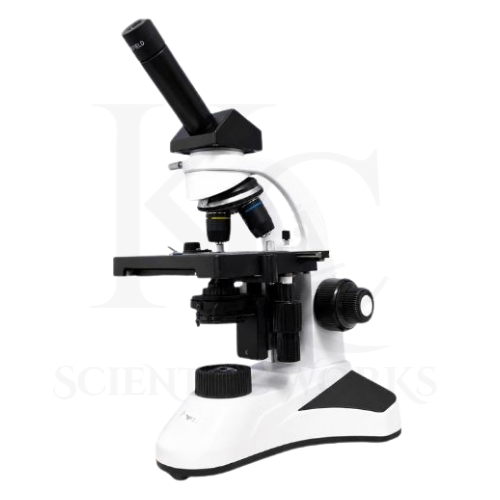
The Co-Axial Monocular Microscope KCX-136 is suitable for biology practical sessions and introductory microscopy education.
Students can learn specimen positioning, objective selection and focusing techniques.
College Laboratories
Colleges can use the microscope for routine biological practical work and observation of prepared microscope slides.
University Laboratory Training
Universities and scientific training institutions can use the KCX-136 for basic microscope operation training and educational specimen examination.
Biological Specimen Observation
The microscope supports observation of suitable prepared cells, tissues and other biological structures.
Botany Laboratories
Botany departments can use the microscope for examining prepared plant tissue sections and other botanical slides.
Zoology Laboratories
The KCX-136 can be used for observing suitable prepared zoological specimens and tissue sections.
Microbiology Education
The microscope can support educational observation of appropriately prepared microorganisms, depending on the installed objective lenses and optical resolution.
Scientific Training Centers
Training institutions can use the microscope to demonstrate compound optical magnification, objective selection and specimen focusing.
Laboratory Demonstrations
Teachers and instructors can use the KCX-136 for demonstrations involving prepared biological slides and basic microscopy principles.
Routine Laboratory Observation
The microscope provides a practical configuration for routine examination of compatible prepared laboratory specimens.
Working Principle
The Co-Axial Monocular Microscope KCX-136 operates using the principle of compound optical magnification.
A prepared specimen is placed on the mechanical stage and positioned beneath the selected objective lens.
Light from the base-integrated illumination system passes through the condenser and specimen.
The selected objective lens forms a magnified image, which is further enlarged by the monocular eyepiece.
The observer views the resulting image through the inclined observation tube.
The revolving nosepiece allows users to select different objective lenses according to the required magnification.
The coaxial coarse and fine focusing controls adjust the relative position of the specimen and objective system to obtain a sharp image.
The mechanical stage supports controlled specimen positioning, allowing different areas of the prepared slide to be examined.
Optical Magnification
Total optical magnification is calculated using:
Total Magnification = Eyepiece Magnification × Objective Magnification
For example, the following combinations apply if the microscope is supplied with a 10X eyepiece and the corresponding objectives:
| Objective Lens | Eyepiece | Total Magnification |
|---|
| 4X | 10X | 40X |
| 10X | 10X | 100X |
| 40X | 10X | 400X |
| 100X | 10X | 1000X |
These are illustrative combinations, not confirmed KCX-136 specifications.
Microscope Compatibility and Usage
The KCX-136 Co-Axial Monocular Microscope is designed for examining compatible prepared microscope slides and suitable biological specimens.
It can be used in schools, colleges, universities, educational laboratories and scientific training institutions.
For routine observation, users should place the prepared slide on the stage, select a suitable low-power objective and adjust the coarse focusing control.
The fine focusing control can then be used to improve image sharpness.
Higher-power objectives may be selected according to the specimen and installed optical configuration.
The microscope should be operated according to the supplied product instructions and compatible electrical requirements.