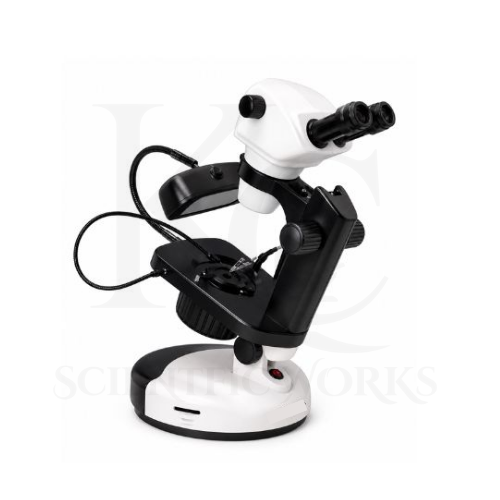
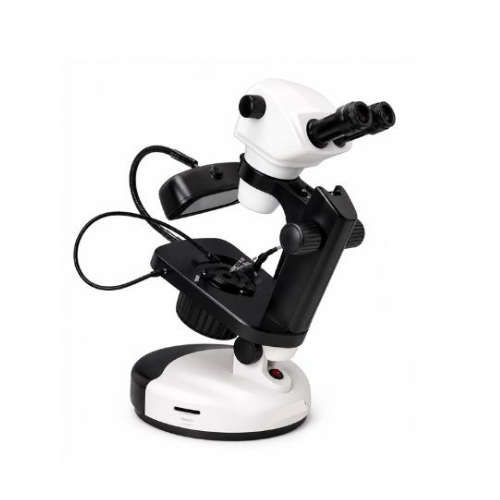
The Gemological Microscope KCX-196 is designed to magnify gemstones, diamonds, jewellery components and other suitable small specimens for detailed visual inspection.
Its binocular stereoscopic optical system provides a three-dimensional viewing effect, helping users examine visible structures at different depths and orientations.
The 7X–45X zoom magnification range allows users to switch between general observation and closer inspection.
Bright-field illumination supports examination of gemstone surfaces and external characteristics.
Dark-field illumination helps reveal selected internal features, including visible inclusions, within suitable transparent or translucent gemstones.
The adjustable iris diaphragm allows users to regulate illumination according to the specimen and observation requirements.
The microscope's 115 mm working distance provides room for positioning gemstones and handling compatible inspection accessories.
The flexible arm stand and focusing controls allow the microscope to be adjusted for comfortable observation.
The vacuum-based diamond holding system and rotatable base support specimen positioning during inspection.
The KCX-196 is therefore intended for gemstone examination, jewellery inspection, diamond observation, gemological education and suitable laboratory applications.
Applications
1. Diamond Inspection
The KCX-196 Gemological Microscope is suitable for magnified visual examination of diamonds.
It can help users observe visible inclusions, facet edges and selected surface characteristics.
2. Gemstone Examination
Gemological laboratories can use the microscope to examine suitable precious and semi-precious gemstones.
3. Diamond Inclusion Observation
Dark-field illumination can assist in visualizing selected internal inclusions within suitable transparent diamonds.
4. Jewellery Manufacturing
Jewellery manufacturers can use the microscope to inspect small components and selected workmanship details.
5. Jewellery Quality Control
The microscope supports visual examination of gemstone settings, surface features and fine jewellery components.
6. Gemstone Cutting and Polishing Inspection
The KCX-196 can be used to inspect visible facet edges, polishing marks and selected surface features.
7. Diamond Grading Support
The microscope can support visual examination used in gemological grading workflows.
Formal grading conclusions require appropriate grading standards, controlled observation conditions and qualified assessment.
8. Gemological Research Laboratories
The microscope is suitable for research-oriented visual examination of gemstones and related materials.
9. Gemological Training Institutes
Educational institutions can use the microscope to demonstrate gemstone inspection methods and stereoscopic observation.
10. Jewellery Design Laboratories
Jewellery design laboratories can use the microscope for examining fine components and selected surface details.
11. Gemstone Trading and Inspection
Gemstone traders and inspection professionals can use the microscope to examine visible gemstone characteristics.
12. Precious Stone Examination
The KCX-196 supports visual examination of compatible precious stones, including suitable rubies, sapphires and emeralds.
13. Surface Defect Observation
The microscope can assist in observing visible scratches, chips and other surface irregularities.
14. Industrial Component Inspection
The stereo zoom optical system can support inspection of compatible small industrial components.
15. Laboratory Specimen Observation
The microscope can be used for suitable laboratory specimens that benefit from stereoscopic magnification.
16. Educational Microscopy
The KCX-196 can support demonstrations of stereo microscopy, zoom magnification and illumination techniques.
Working Principle
The Gemological Microscope KCX-196 operates using the principles of stereoscopic optical magnification, reflected-light illumination and controlled specimen positioning.
A gemstone or suitable specimen is positioned beneath the microscope's observation head.
The illumination system directs light toward the specimen using the selected bright-field or dark-field configuration.
In bright-field observation, the specimen is illuminated to provide a general view of its visible surfaces and structures.
In dark-field observation, illumination is directed in a manner that reduces direct background light entering the objective while allowing selected internal features to scatter light toward the optical system.
The stereo zoom optics collect light from the specimen and form magnified images.
The binocular observation system presents slightly different perspectives to the observer's left and right eyes, creating a stereoscopic viewing effect.
The operator can adjust magnification between 7X and 45X according to the inspection requirement.
The focusing knobs are used to obtain a sharp image.
The vacuum-based holding arrangement and rotatable base allow suitable gemstones to be repositioned for examination from different angles.
Gemstone Observation Process
Specimen Placement: The gemstone is positioned using a compatible holder.
Illumination Selection: Bright-field or dark-field illumination is selected.
Magnification Adjustment: The zoom system is adjusted within the 7X–45X range.
Focusing: The stand-mounted focusing controls are adjusted to obtain a clear image.
Specimen Rotation: The specimen holder or rotatable base is used to change the viewing angle.
Visual Inspection: Visible surface characteristics, inclusions and other features are examined.
Observation Recording: Findings may be documented using a separate compatible imaging arrangement where available.
Magnification System
| Parameter | Specification |
|---|
| Magnification Type | Stereo Zoom |
| Magnification Range | 7X–45X |
| Eyepieces | WF10X / 20 mm |
| Observation Head | Binocular |
| Viewing Method | Stereoscopic |
| Working Distance | 115 mm |
| Zoom Ratio | Approximately 6.4:1, Based on the Stated Magnification Range |
Magnification Selection
| Magnification | Typical Observation Purpose |
|---|
| 7X | General gemstone overview |
| 10X | Routine visual inspection |
| 20X | Closer examination of visible features |
| 30X | Detailed surface and inclusion observation |
| 45X | High-magnification inspection of fine details |
The table illustrates observation purposes at magnifications within the stated zoom range. It does not imply fixed zoom detents at these settings.
Bright-Field and Dark-Field Illumination
| Parameter | Bright Field | Dark Field |
|---|
| Main Purpose | General specimen examination | Enhanced visibility of selected internal features |
| Illumination | Direct or reflected illumination | Oblique illumination arrangement |
| Background Appearance | Generally brighter | Comparatively darker |
| Typical Application | Surface and facet inspection | Inclusion observation in suitable gemstones |
| Microscope Compatibility | Supported | Supported |
Gemstone and Diamond Inspection
The KCX-196 Gemological Microscope is intended to support examination of visible gemstone characteristics.
Diamond Cut Examination
The microscope can assist in observing facet arrangement, edges and selected workmanship details.
Gemstone Colour Observation
The microscope can support visual examination of colour appearance under suitable lighting conditions.
Formal colour grading requires standardized illumination and grading procedures.
Inclusion Examination
Dark-field illumination can help reveal certain inclusions within transparent gemstones.
Surface Inspection
The microscope supports observation of scratches, chips, polishing marks and other visible surface features.
Jewellery Component Inspection
The stereo zoom system can be used to examine small jewellery components and stone settings.
Microscope Compatibility and Usage
The KCX-196 Gemological Microscope is designed for observation of compatible gemstones, diamonds, jewellery components and laboratory specimens.
It can be used in gemological laboratories, jewellery workshops, inspection centers, educational institutions and quality-control environments.
For routine inspection, the specimen should be secured using the supplied compatible holder.
The microscope's flexible arm and focusing system should be adjusted to obtain a suitable viewing position.
Bright-field illumination can be used for general observation, while dark-field illumination can be selected for suitable internal feature examination.
The zoom magnification can be adjusted according to the size and characteristics of the specimen.
The rotatable base allows the specimen to be examined from different angles.
The microscope should be operated according to its final supplied technical configuration and electrical safety instructions.