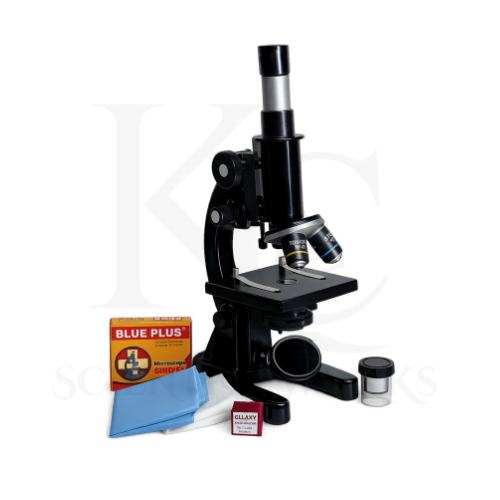
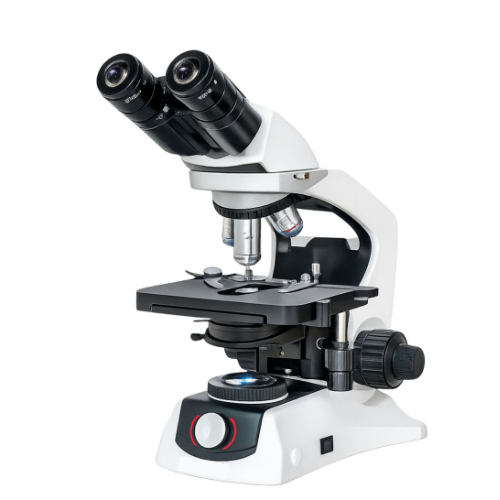
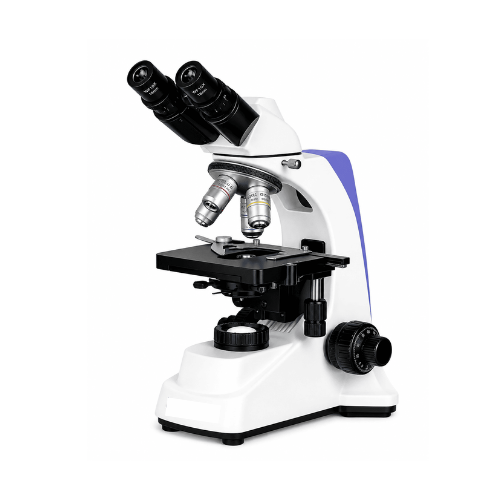
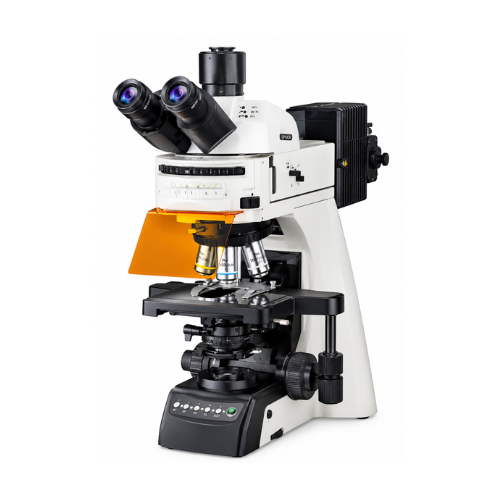
The Junior Compound Microscope KCX-102 is designed to introduce students and beginners to the principles of optical microscopy.
It allows users to observe suitable prepared specimens at higher magnification than is possible with the unaided eye.
The microscope uses a wide-field eyepiece and achromatic objective lenses to produce magnified images.
Its LED illumination system provides light for examining specimens.
The triple revolving nosepiece allows students to select between the installed objectives.
Coarse and fine focusing controls help bring the specimen into clear view.
The fixed stage and slide clips support placement of prepared microscope slides.
The KCX-102 is suitable for learning microscope handling, basic biology observation and practical laboratory techniques.
Applications
1. School Science Laboratories
The KCX-102 Junior Compound Microscope is suitable for introductory microscopy practicals in school laboratories.
2. Biology Practical Classes
Students can use the microscope to observe suitable prepared biological specimens.
3. Educational Demonstrations
Teachers can demonstrate magnification, focusing and basic microscope operation.
4. Basic Specimen Observation
The microscope supports observation of compatible prepared slides and specimens.
5. Student Science Projects
The KCX-102 can be used in suitable classroom science projects involving optical microscopy.
6. Classroom Scientific Experiments
The microscope supports introductory practical exercises in biology and general science.
7. Microscope Handling Training
Students can practice objective selection, slide positioning and focusing.
8. Plant Tissue Observation
The microscope can be used to observe suitable prepared plant tissue slides.
9. Plant Cell Observation
Students can examine visible cellular structures in appropriately prepared plant specimens.
10. Basic Animal Tissue Observation
The microscope supports examination of suitable prepared animal tissue slides.
11. Prepared Microorganism Slides
Students can observe certain microorganisms using suitable prepared slides, depending on specimen size and optical resolution.
12. Introductory Cell Biology
The microscope supports educational activities involving basic cellular structure.
13. Laboratory Skill Development
Students can develop fundamental microscopy skills through supervised practical observation.
14. College Foundation Laboratories
The KCX-102 can support introductory microscopy exercises in suitable foundation-level laboratory courses.
15. Science Education Programs
Educational institutions can use the microscope for basic practical microscopy instruction.
Typical Observation Areas
| Observation Area | Educational Purpose |
|---|
| Prepared Plant Cells | Introduction to plant cell structure |
| Onion Epidermis | Observation of visible plant cell boundaries |
| Leaf Tissue | Examination of suitable prepared leaf specimens |
| Prepared Animal Cells | Basic observation of cellular morphology |
| Prepared Tissue Slides | Introduction to biological tissue structure |
| Pond Water Samples | Observation of suitable visible microorganisms and particles |
| Prepared Microorganism Slides | Introduction to microscopic organisms |
| Fibres | Observation of fibre appearance and structure |
| Thin Biological Sections | Study of suitable prepared biological specimens |
| Educational Slides | Practice with magnification and focusing |
Working Principle
The Junior Compound Microscope KCX-102 operates using the principle of compound optical magnification.
A suitable specimen is placed on a microscope slide and positioned on the stage.
The LED illumination system provides light for observation.
Light passing through the specimen enters the selected objective lens.
The objective forms a magnified intermediate image.
The WF10X eyepiece further magnifies this image for the observer.
The total nominal magnification is calculated by multiplying the eyepiece magnification by the objective magnification.
The microscope's coarse and fine focusing controls allow the user to adjust image sharpness.
Basic Microscope Observation Process
Slide Placement: Position a suitable prepared specimen slide on the microscope stage.
Slide Securing: Use the stage clips to hold the slide.
Illumination: Switch on the LED light source.
Objective Selection: Begin with the lower-power objective.
Initial Focusing: Use the coarse focusing control to locate the specimen.
Fine Focusing: Adjust the fine focus for a clearer image.
Higher Magnification: Select the higher-power objective when required, checking clearance and using fine focusing.
Observation: Examine the visible specimen structures through the eyepiece.
Magnification System
| Objective | Eyepiece | Calculated Total Magnification |
|---|
| 10X Achromatic | WF10X | 100X |
| 40X Achromatic | WF10X | 400X |
Magnification note: The supplied reference describes magnification as up to 100X, but it also specifies a WF10X eyepiece and 40X objective. This combination produces 400X nominal magnification. The final KCX-102 specification should be confirmed before publishing the magnification claim.
Optical and Illumination System
| Parameter | Specification |
|---|
| Observation Type | Monocular |
| Eyepiece | WF10X Wide Field |
| Objectives | 10X and 40X Achromatic |
| Nosepiece | Triple Revolving |
| Light Source | LED |
| Focusing | Coarse and Fine |
| Stage | Fixed with Slide Clips |
| Body | Metal Construction |
Educational Benefits
The KCX-102 Junior Compound Microscope helps students understand basic scientific observation through practical experience.
It supports learning about:
Optical magnification and image formation
Microscope components and their functions
Objective lens selection
Proper slide positioning
Coarse and fine focusing
Prepared biological specimen observation
Basic plant and animal cell structures
Introductory laboratory practices
Scientific observation and recording
Care and handling of optical instruments
Microscope Compatibility and Usage
The KCX-102 is designed for educational microscopy using suitable prepared slides.
The microscope should be positioned on a stable laboratory surface.
Students should begin observation using the lower-power objective.
The LED illumination should be adjusted according to the available controls and specimen requirements.
The microscope slide should be secured with the stage clips.
Coarse focusing should be performed carefully, particularly when the objective is close to the slide.
At higher magnification, fine focusing should be used to avoid contact between the objective and specimen.
The eyepiece and objectives should be cleaned using appropriate optical cleaning materials.
The microscope should be stored in a clean and dry environment when not in use.