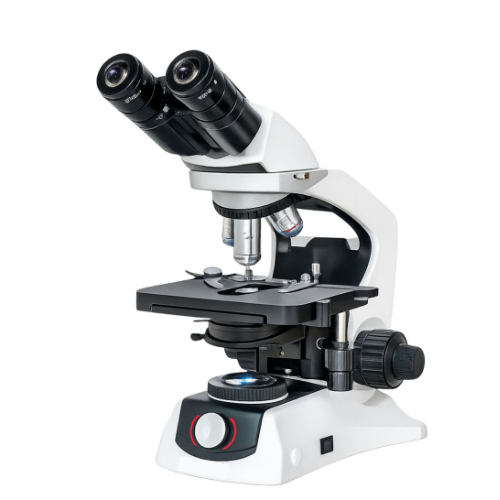
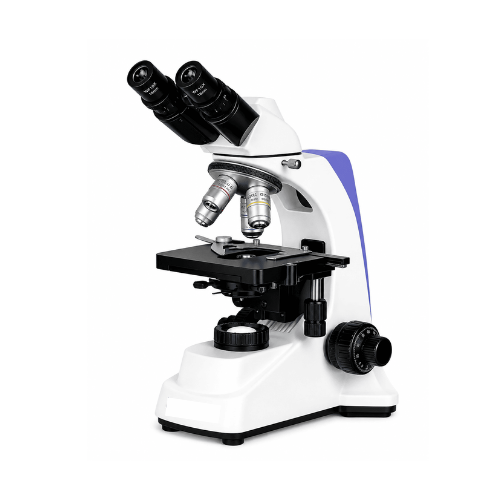
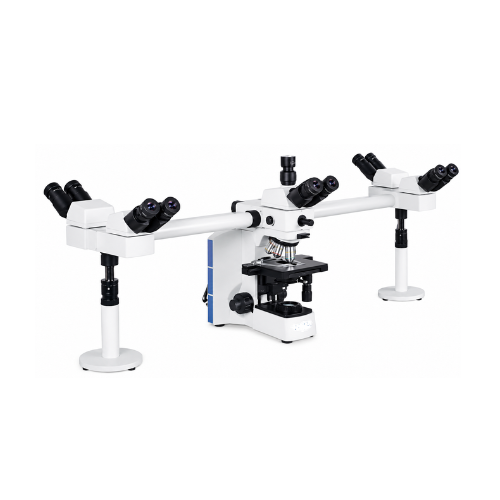
The Penta Head Microscope KCX-177 is developed for simultaneous microscopic observation by multiple users.
It features five binocular viewing heads, allowing up to five observers to examine the same specimen during a microscopy session.
This arrangement is particularly useful for medical colleges, dental colleges, universities, teaching laboratories and professional microscopy training centers.
The microscope incorporates achromatic objectives with magnifications of 4X, 10X, 40X and 100X.
Combined with the WF10X eyepieces, the microscope provides nominal magnifications from 40X to 1000X.
The swing condenser supports transmitted-light illumination.
The coaxial coarse and fine focusing controls allow the operator to adjust specimen focus.
The mechanical stage provides a platform for positioning prepared slides.
The adjustable LED pointer helps instructors indicate specific specimen structures during group observation.
The KCX-177 is intended for microscopy teaching, histology education, pathology demonstrations, biological specimen observation and collaborative laboratory training.
Applications
1. Medical Colleges
The KCX-177 Penta Head Microscope supports collaborative observation of prepared biological and histology specimens.
2. Dental Colleges
The microscope is suitable for group microscopy demonstrations in dental education.
3. Microscopy Teaching
Instructors can demonstrate specimen structures to several students simultaneously.
4. Laboratory Training
The microscope supports practical instruction in biological microscopy.
5. Histology Laboratories
The KCX-177 can be used for examination of prepared tissue sections.
6. Pathology Teaching Laboratories
The microscope supports educational observation of prepared pathology slides.
7. Biological Research
The KCX-177 can be used for collaborative observation of suitable biological specimens.
8. Research Institutes
Research teams can examine specimens together during scientific discussions.
9. Universities
The microscope supports advanced microscopy instruction in university laboratories.
10. Colleges
The KCX-177 is suitable for practical laboratory demonstrations and training.
11. Microbiology Training
The microscope can support group observation of appropriately prepared microorganisms.
12. Biotechnology Education
The KCX-177 can be used for microscopy instruction in biotechnology courses.
13. Scientific Demonstrations
The microscope allows instructors to highlight specimen features during demonstrations.
14. Group Specimen Observation
Up to five observers can examine the same specimen through the supplied viewing heads.
15. Collaborative Research Discussions
The microscope supports group examination and discussion of microscopic observations.
16. Medical Laboratory Training
The KCX-177 can be used for educational specimen examination in medical laboratory courses.
17. Anatomy and Histology Education
The microscope supports teaching involving suitable prepared tissue slides.
18. Laboratory Skill Development
Students can learn focusing, objective selection and specimen observation techniques.
19. Professional Microscopy Workshops
The KCX-177 is suitable for instructor-led microscopy workshops.
20. Group Laboratory Demonstrations
The microscope supports coordinated observation of specimens during practical sessions.
Pentahead Multi-Viewing Configuration
The KCX-177 Penta Head Microscope features a five-head binocular observation system.
The multi-viewing arrangement allows up to five users to observe the same specimen simultaneously.
This is useful in educational environments where an instructor needs to explain specimen features to several participants.
Multihead Observation Benefits
Simultaneous viewing by five observers
Shared specimen observation
Instructor-led microscopy demonstrations
Group histology teaching
Pathology education
Collaborative laboratory training
Scientific discussions
Practical microscopy instruction
Visual identification of specimen structures
Group biological specimen examination
Multihead Configuration Specifications
| Parameter | Specification |
|---|
| Microscope Configuration | Pentahead |
| Number of Viewing Heads | 5 |
| Viewing Head Type | Binocular |
| Observation Capacity | Up to 5 Observers |
| Optical System | Achromatic |
| Eyepieces | WF10X / 18 mm |
| Pointer | LED |
| Pointer Brightness | Adjustable |
| Primary Use | Collaborative Microscopy |
Optical System and Objectives
The KCX-177 features an achromatic optical system with four objective magnifications.
| Objective | Type | Total Magnification with WF10X |
|---|
| 4X | Achromatic | 40X |
| 10X | Achromatic | 100X |
| 40X | Achromatic | 400X |
| 100X | Achromatic | 1000X |
The achromatic optical configuration supports observation of suitable prepared biological specimens.
Magnification System
The total nominal magnification is calculated by multiplying the eyepiece magnification by the selected objective magnification.
| Eyepiece | Objective | Total Magnification |
|---|
| WF10X | 4X | 40X |
| WF10X | 10X | 100X |
| WF10X | 40X | 400X |
| WF10X | 100X | 1000X |
Standard nominal magnification range: 40X–1000X.
Mechanical Stage
The microscope incorporates a plain-layer mechanical stage for positioning suitable prepared microscope slides.
Stage Specifications
| Parameter | Specification |
|---|
| Stage Type | Plain-Layer Mechanical |
| Stage Size | 140 × 140 mm |
| Observation Method | Transmitted Light |
| Suitable Specimens | Prepared Microscope Slides |
Condenser System
The KCX-177 incorporates a swing condenser for transmitted-light microscopy.
The condenser directs illumination toward the specimen to support optical observation.
Condenser Specifications
| Parameter | Specification |
|---|
| Condenser Type | Swing Condenser |
| Numerical Aperture | 0.9 / 0.25 |
| Illumination Method | Transmitted Light |
| Primary Function | Directing Light Toward Specimen |
Focusing System
The KCX-177 Penta Head Microscope features coaxial coarse and fine focusing controls.
The coarse focusing mechanism allows initial focus adjustment.
The fine focusing mechanism supports smaller adjustments for improved image sharpness.
Focusing Specifications
| Parameter | Specification |
|---|
| Focusing Type | Coaxial Coarse and Fine |
| Fine Adjustment Division | 0.002 mm |
| Fine Adjustment Division in Micrometers | 2 µm |
| Operation | Manual |
Illumination System
The microscope uses a 6V / 30W halogen lamp for transmitted-light observation.
The brightness can be adjusted according to specimen and observation requirements.
Illumination Specifications
| Parameter | Specification |
|---|
| Illumination Type | Halogen |
| Lamp Rating | 6V / 30W |
| Brightness Adjustment | Available |
| Observation Method | Transmitted Light |
| Condenser | Swing Condenser |
LED Pointer System
The KCX-177 incorporates an LED pointer with adjustable brightness.
The pointer is designed to help the instructor or primary operator indicate specific specimen features during simultaneous viewing.
Pointer Specifications
| Parameter | Specification |
|---|
| Pointer Type | LED |
| Brightness Adjustment | Available |
| Primary Function | Highlighting Specimen Features |
| Application | Teaching and Shared Observation |
Working Principle
The Penta Head Microscope KCX-177 operates using compound transmitted-light microscopy combined with a multi-observer optical viewing arrangement.
A suitable prepared specimen is positioned on the mechanical stage.
The halogen illumination system directs light toward the specimen through the condenser.
The selected objective collects transmitted light and forms a magnified image.
The multi-viewing optical arrangement distributes the specimen image to the five binocular viewing heads.
This allows up to five observers to examine the same specimen.
The coaxial coarse and fine focusing controls allow the operator to adjust image sharpness.
The LED pointer can be used to indicate areas of interest during shared observation.
Basic Observation Process
Microscope Placement: Position the microscope on a stable laboratory surface with sufficient space for all observers.
Specimen Preparation: Prepare or select a suitable microscope slide.
Slide Positioning: Place the slide on the mechanical stage.
Illumination: Switch on the halogen illumination system.
Objective Selection: Begin with the 4X objective.
Coarse Focusing: Carefully adjust the coarse focus to locate the specimen.
Fine Focusing: Use the fine focus to obtain a clear image.
Shared Observation: Allow observers to examine the specimen through the five binocular heads.
Pointer Adjustment: Use the LED pointer to highlight areas of interest.
Higher Magnification: Select the appropriate higher-power objective when needed.
Specimen Examination: Observe and discuss visible specimen structures.
Completion: Return to a lower-power objective and switch off the illumination after use.
Typical Observation Areas
| Observation Area | Educational Purpose |
|---|
| Prepared Histology Slides | Group tissue observation |
| Pathology Teaching Slides | Collaborative specimen examination |
| Plant Cells | Observation of cellular structures |
| Animal Cells | Biological microscopy education |
| Tissue Sections | Histology demonstrations |
| Prepared Blood Smears | Educational blood cell observation |
| Microorganism Slides | Group microbiology training |
| Biological Specimens | Routine microscopic examination |
| Medical Teaching Slides | Instructor-led demonstrations |
| Laboratory Slide Collections | Practical microscopy training |
Educational and Research Benefits
The KCX-177 Penta Head Microscope supports collaborative learning by allowing multiple users to examine the same specimen.
It helps students and laboratory personnel develop skills in:
Biological specimen observation
Optical magnification
Objective selection
Coarse and fine focusing
Microscope slide handling
Group histology examination
Pathology teaching
Collaborative scientific discussion
Shared specimen identification
Laboratory microscopy techniques
Medical and dental microscopy education
Scientific demonstration procedures
Microscope Compatibility and Usage
The KCX-177 Penta Head Microscope is intended for collaborative observation of suitable prepared biological specimens.
It is suitable for medical colleges, dental colleges, universities, teaching laboratories and microscopy training centers.
The microscope should be positioned on a stable laboratory bench with sufficient room for all viewing heads.
The halogen illumination should be adjusted according to specimen requirements.
Prepared slides should be positioned securely on the mechanical stage.
Observation should begin with the lowest-power objective.
The coaxial focusing controls should be adjusted carefully.
The LED pointer may be used to indicate specimen features during shared observation.
The 100X objective should be operated according to its confirmed immersion requirements.
After use, the optical components should be cleaned with suitable optical cleaning materials.
The microscope should be stored in a clean and dry environment.