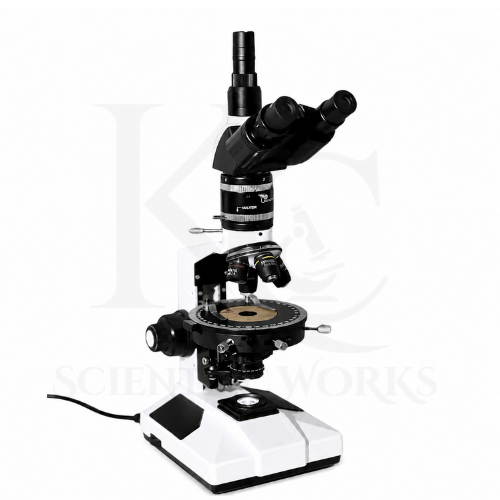
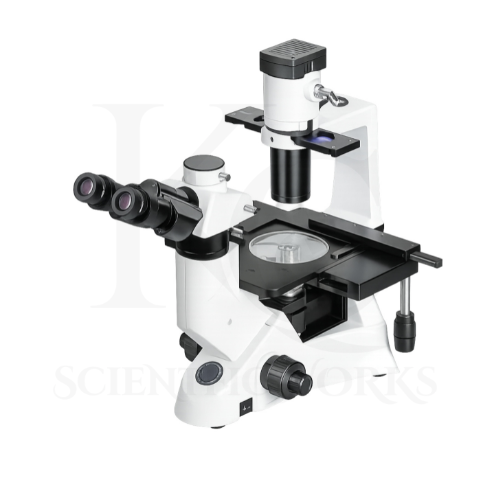
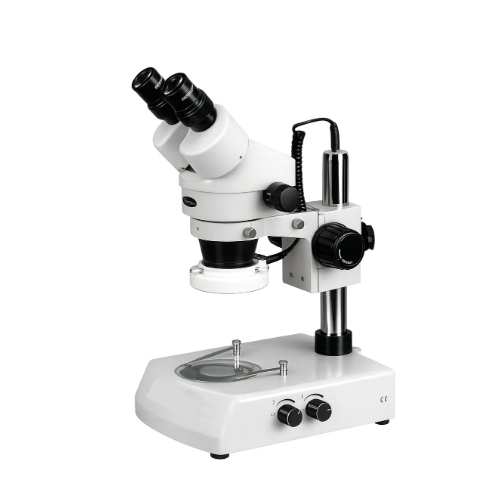
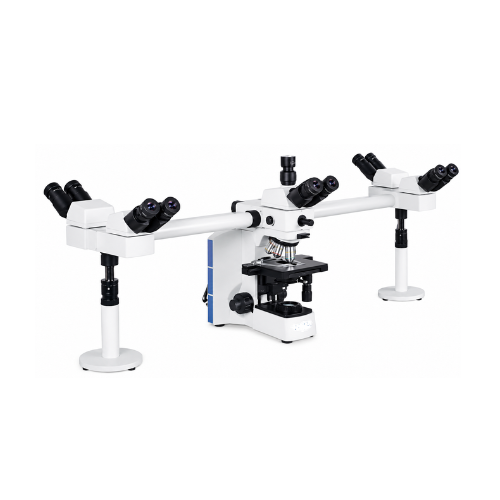
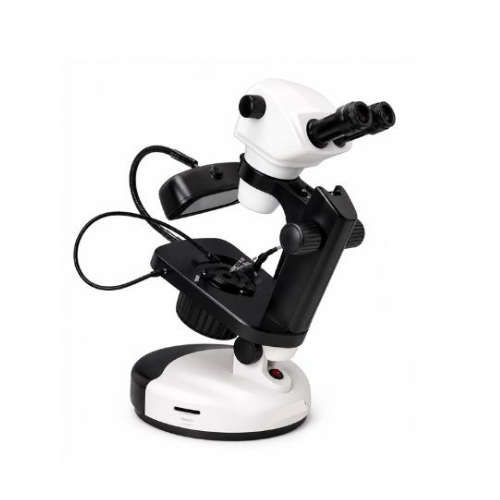
The Polarizing Microscope KCX-125 is designed for examination of suitable anisotropic materials using polarized light.
It is particularly useful for observing minerals, crystals, geological thin sections and materials that interact differently with light depending on their optical orientation.
The microscope incorporates a rotatable polarizer and swing-out analyzer to support polarized-light examination.
Its graduated circular stage allows specimens to be rotated during observation.
This helps users study optical characteristics such as birefringence, interference colors and extinction behavior.
The strain-free optical system supports examination of materials without introducing excessive unwanted polarization effects from the microscope optics.
The built-in Bertrand lens supports conoscopic observation of suitable specimens.
The trinocular viewing head allows direct visual observation and compatible digital imaging.
The KCX-125 is intended for petrography, mineralogy, crystallography, materials research, geological education and appropriate industrial inspection.
Applications
1. Geological Survey Laboratories
The KCX-125 Polarizing Microscope supports polarized-light examination of suitable geological specimens.
2. Petrography Laboratories
The microscope can be used for examination of prepared rock thin sections.
3. Mineral Identification
The KCX-125 supports observation of optical characteristics used in mineral identification.
4. Crystallography Research
The microscope can be used to study suitable crystalline materials and their optical properties.
5. Metallurgical Analysis
The microscope supports appropriate polarized-light examination of prepared metallurgical specimens.
6. Ceramic Industry
The KCX-125 can be used for optical examination of suitable ceramic materials.
7. Semiconductor Inspection
The microscope can support polarized-light inspection of compatible semiconductor-related materials.
8. Glass Manufacturing
The microscope can be used for examining suitable glass specimens and optical stress patterns.
9. Textile Fibre Analysis
The KCX-125 supports examination of suitable fibers using polarized-light microscopy.
10. Polymer Research
The microscope can assist in studying birefringent structures in compatible polymer specimens.
11. Pharmaceutical Material Analysis
The microscope can support polarized-light examination of suitable crystalline pharmaceutical materials.
12. Chemical Research Laboratories
The KCX-125 can be used for optical analysis of compatible crystalline substances.
13. Universities and Colleges
The microscope supports education in mineralogy, geology, crystallography and optical microscopy.
14. Forensic Science Laboratories
The microscope can support examination of suitable fibers, particles and crystalline trace materials.
15. Materials Science Research
The KCX-125 supports investigation of appropriate optically anisotropic materials.
16. Mineralogical Research
The microscope can be used to examine optical properties of prepared mineral specimens.
17. Geological Thin-Section Analysis
The KCX-125 supports observation of mineral structures in prepared geological thin sections.
18. Crystal Orientation Studies
The microscope can assist in examining crystal orientation using polarized-light techniques.
19. Industrial Quality Control
The microscope can support suitable polarized-light inspection tasks.
20. Advanced Laboratory Training
The KCX-125 supports practical training in orthoscopic and conoscopic microscopy.
Typical Specimens and Observations
| Specimen | Observation Purpose |
|---|
| Geological Thin Sections | Mineral identification and texture examination |
| Mineral Crystals | Birefringence and extinction observation |
| Rock Specimens | Petrographic examination |
| Crystalline Materials | Optical anisotropy studies |
| Glass Samples | Suitable optical stress examination |
| Polymer Films | Birefringence observation |
| Textile Fibres | Fiber structure and optical property examination |
| Ceramic Materials | Optical characterization |
| Pharmaceutical Crystals | Crystal observation |
| Forensic Trace Materials | Polarized-light examination |
| Geological Research Samples | Mineralogical analysis |
| Prepared Material Sections | Structural and optical examination |
Working Principle
The Polarizing Microscope KCX-125 operates on the principle of polarized-light microscopy.
Light from the LED illumination system passes through the polarizer, which selects a particular polarization orientation.
The polarized light then passes through the specimen positioned on the rotating stage.
When light interacts with an anisotropic specimen, such as a birefringent mineral or crystal, its polarization state can change.
The analyzer allows suitable polarization-dependent image contrast to be observed.
When the polarizer and analyzer are arranged in crossed positions, many birefringent specimens display interference colors and extinction behavior.
By rotating the specimen stage, the observer can examine how the specimen's optical appearance changes with orientation.
The microscope can also be configured for conoscopic observation using the Bertrand lens and appropriate illumination conditions.
This allows suitable interference figures to be examined for crystallographic and mineralogical analysis.
Basic Polarizing Microscope Observation Process
Microscope Setup: Position the KCX-125 on a stable laboratory bench.
Specimen Preparation: Prepare a suitable geological thin section or compatible material specimen.
Stage Positioning: Place the specimen on the circular rotating stage.
Illumination: Switch on the LED illumination system.
Objective Selection: Begin observation with a lower-power objective.
Initial Focusing: Use coarse and fine focusing controls to obtain a clear image.
Polarizer Adjustment: Select the required polarizer orientation.
Analyzer Selection: Insert or remove the analyzer according to the observation method.
Stage Rotation: Rotate the specimen stage to examine changes in optical appearance.
Optical Examination: Observe interference colors, extinction and other suitable optical characteristics.
Conoscopic Observation: Use the Bertrand lens and appropriate optical settings when interference figure examination is required.
Image Documentation: Capture images using a compatible camera when installed.
Magnification System
The KCX-125 uses WF10X eyepieces with the specified objective lenses.
| Objective | Eyepiece | Total Magnification |
|---|
| 4X | WF10X | 40X |
| 10X | WF10X | 100X |
| 20X | WF10X | 200X |
| 40X | WF10X | 400X |
| 60X | WF10X | 600X |
| Optional 100X Oil | WF10X | 1000X |
Standard nominal magnification range: 40X–600X.
Maximum with optional objective: 1000X.
Optical System and Objectives
| Parameter | Specification |
|---|
| Optical System | Infinity-Corrected |
| Optical Configuration | Strain-Free |
| Objective Type | Plan Achromatic |
| Standard Objectives | 4X, 10X, 20X, 40X and 60X |
| Optional Objective | 100X Oil |
| Eyepieces | WF10X / 22 mm |
| Viewing Head | Trinocular Siedentopf |
| Interpupillary Distance | 48–75 mm |
| Nosepiece | Quintuple |
Polarizer and Analyzer System
The KCX-125 incorporates a polarization assembly intended for research-oriented polarized-light observation.
Polarization Specifications
| Parameter | Specification |
|---|
| Polarizer | Rotatable |
| Polarizer Rotation | 360° |
| Analyzer | Swing-Out |
| Bertrand Lens | Built-In |
| Compensator Slot | Included |
| Orthoscopic Observation | Supported |
| Conoscopic Observation | Supported with Appropriate Setup |
| Primary Purpose | Polarized-Light Examination |
Precision Rotating Stage
The microscope features a circular graduated rotating stage for positioning and rotating specimens.
Stage Specifications
| Parameter | Specification |
|---|
| Stage Type | Circular Rotating |
| Graduation | Provided |
| Rotation | 360° |
| Diameter | Approximately 160 mm |
| Primary Purpose | Specimen Rotation During Polarized-Light Observation |
Condenser and Illumination System
The KCX-125 features a strain-free polarizing condenser with an iris diaphragm.
Its LED Köhler illumination system is intended to provide controlled transmitted-light illumination.
Illumination Specifications
| Parameter | Specification |
|---|
| Condenser | Strain-Free Polarizing |
| Diaphragm | Iris |
| Illumination | High-Brightness LED |
| Illumination Method | Köhler |
| Filters | Blue, Green, Yellow and Frosted |
| Power Supply | AC 100–240V, 50/60Hz |
Focusing System
The microscope features coaxial coarse and fine focusing controls for adjusting specimen focus.
Focusing Specifications
| Parameter | Specification |
|---|
| Focusing Type | Coaxial Coarse and Fine |
| Fine Focus Accuracy | 0.002 mm |
| Fine Focus Accuracy in Micrometers | 2 µm |
| Primary Function | Precise Specimen Focusing |
Orthoscopic and Conoscopic Observation
Orthoscopic Observation
Orthoscopic polarized-light microscopy is used to examine suitable specimen features under conventional focused observation.
It can support study of mineral appearance, interference colors, extinction and other optical characteristics.
Conoscopic Observation
Conoscopic microscopy uses a convergent-light arrangement to examine interference figures in suitable anisotropic specimens.
The built-in Bertrand lens supports viewing of these figures when the microscope is correctly configured.
This technique can assist with appropriate crystallographic investigations.
Digital Imaging Compatibility
The KCX-125 includes a trinocular photo port for compatible digital microscope cameras.
A suitable camera and optical adapter can be used for image documentation.
Digital Imaging Specifications
| Parameter | Specification |
|---|
| Camera Port | Trinocular |
| Digital Camera Compatibility | Yes |
| Camera Resolution | Not Specified |
| Camera Interface | Not Specified |
| Imaging Software | Not Specified |
| Camera Inclusion | Not Confirmed |
Educational and Research Benefits
The KCX-125 Polarizing Microscope supports training and research involving polarized-light microscopy.
It helps users study:
Polarized-light microscopy principles
Optical anisotropy
Birefringence
Interference colors
Extinction behavior
Mineral identification
Geological thin-section observation
Crystal orientation
Orthoscopic microscopy
Conoscopic microscopy
Bertrand lens operation
Polarizer and analyzer adjustment
Graduated stage rotation
Optical focusing
Digital specimen documentation
Microscope Compatibility and Usage
The KCX-125 Polarizing Microscope is intended for examination of suitable geological, mineralogical, crystalline and industrial material specimens.
It can be used in geology departments, petrography laboratories, research institutions, universities and materials science laboratories.
The microscope should be positioned on a stable laboratory surface.
Specimens should be prepared using appropriate laboratory methods.
Observation should begin with a lower-power objective.
The polarizer and analyzer should be adjusted according to the intended observation mode.
The circular stage may be rotated to examine changes in specimen appearance.
The Bertrand lens should be used with appropriate optical settings for conoscopic observation.
Compatible compensators may be installed through the provided slot when required.
A suitable camera can be connected to the trinocular port for image documentation.
After use, the optical components should be cleaned with appropriate optical cleaning materials.
The microscope should be stored in a clean and dry environment.