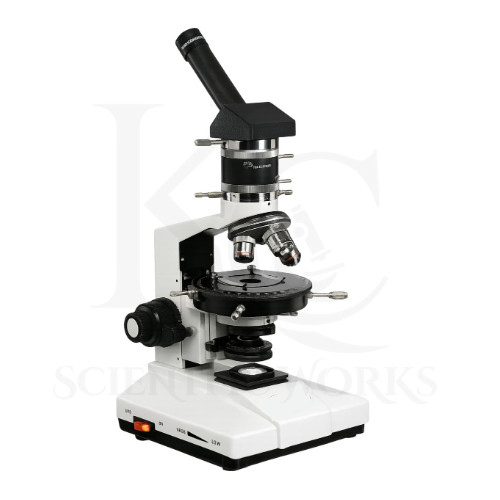
The Polarizing Monocular Microscope KCX-124 is intended for student-level examination of minerals, crystals, geological thin sections and suitable anisotropic materials using polarized light.
It provides a monocular observation arrangement with polarizing accessories for laboratory instruction.
The built-in halogen illumination system directs light through the adjustable condenser and graduated polarizer.
The specimen is positioned on a circular stage that can rotate through 360°.
When polarized light interacts with a suitable birefringent specimen, its polarization state can change.
The sliding analyzer allows polarization-dependent image effects to be observed.
The half-wave and quarter-wave compensators support additional instructional studies of polarized light.
The coaxial focusing system allows adjustment of specimen focus.
The microscope is intended for geology practical classes, mineralogy education, crystallography demonstrations, optical physics training and introductory materials science studies.
Applications
1. Mineralogy Education
The KCX-124 Polarizing Monocular Microscope supports observation of suitable minerals and their optical characteristics.
2. Crystallography Education
The microscope can be used to demonstrate polarization effects in crystalline specimens.
3. Geology Laboratory Training
Students can use the microscope for geological practical exercises.
4. Rock Thin-Section Examination
The KCX-124 supports examination of prepared rock thin sections.
5. Crystal Thin-Section Observation
The microscope can be used for suitable prepared crystalline specimens.
6. Materials Science Education
The microscope supports instructional observation of optically anisotropic materials.
7. Fiber Analysis
The KCX-124 can be used to examine suitable fibers using polarized light.
8. Optical Physics Demonstrations
The microscope supports demonstrations of polarized-light behavior.
9. Birefringence Studies
Students can examine birefringence effects in compatible specimens.
10. Interference Color Observation
The microscope can be used to demonstrate interference colors in suitable materials.
11. Extinction Angle Studies
The graduated rotating stage supports instructional examination of extinction behavior.
12. Mineral Identification Training
The KCX-124 can assist students in learning optical mineral identification techniques.
13. University Geology Departments
The microscope is suitable for practical teaching in geological sciences.
14. College Science Laboratories
The KCX-124 supports educational microscopy activities.
15. Petrography Training
The microscope can be used for introductory petrographic observation.
16. Anisotropic Material Analysis
Students can observe polarization-dependent optical behavior in compatible materials.
17. Compensator Demonstrations
The half-wave and quarter-wave compensators support instructional polarization experiments.
18. Polarizer and Analyzer Training
The microscope allows students to learn the operation of polarizing optical components.
19. Scientific Laboratory Workshops
The KCX-124 is suitable for instructor-led polarized-light microscopy workshops.
20. Educational Research Projects
The microscope can support appropriate student projects involving optical microscopy and geological specimens.
Typical Specimens and Observations
| Specimen | Observation Purpose |
|---|
| Mineral Thin Sections | Optical mineral identification |
| Rock Thin Sections | Petrographic observation |
| Crystalline Materials | Polarization-dependent optical examination |
| Quartz Specimens | Birefringence demonstrations |
| Mica Samples | Interference color and extinction studies |
| Transparent Minerals | Polarized-light observation |
| Textile Fibers | Optical anisotropy examination |
| Polymer Films | Birefringence demonstrations |
| Prepared Geological Slides | Student laboratory training |
| Crystal Samples | Optical orientation studies |
| Anisotropic Materials | Polarization behavior examination |
Working Principle
The Polarizing Monocular Microscope KCX-124 operates on the principle of transmitted polarized-light microscopy.
Light from the built-in halogen lamp passes through the condenser and polarizer.
The polarizer produces light with a selected polarization orientation.
This polarized light passes through the specimen positioned on the rotating circular stage.
When the specimen is optically anisotropic, its interaction with polarized light depends on its internal structure and orientation.
A birefringent specimen can divide the incident light into components that experience different refractive indices.
The sliding analyzer allows these polarization changes to produce visible intensity differences and, under suitable conditions, interference colors.
Rotating the stage changes the orientation of the specimen relative to the polarization direction.
This allows students to observe extinction behavior and other polarization-dependent characteristics.
The supplied half-wave and quarter-wave compensators can be introduced for additional polarization demonstrations.
The condenser and illumination controls support adjustment of specimen lighting.
Basic Observation Procedure
Microscope Setup: Place the KCX-124 on a stable laboratory bench.
Specimen Preparation: Select a suitable prepared mineral, crystal or geological thin section.
Stage Positioning: Position the specimen on the circular rotating stage.
Illumination: Switch on the built-in halogen lamp.
Brightness Adjustment: Use the solid-state light control to set suitable illumination.
Objective Selection: Begin with a lower-power objective.
Initial Focusing: Adjust the coaxial focusing controls until the specimen is clearly visible.
Polarizer Adjustment: Insert and rotate the polarizer as required.
Analyzer Selection: Introduce the sliding analyzer for crossed-polarized observation.
Stage Rotation: Rotate the stage to examine changes in specimen appearance.
Compensator Use: Insert the appropriate half-wave or quarter-wave compensator when required.
Observation: Examine interference colors, extinction and other suitable optical characteristics.
Completion: Return the optical components to their appropriate positions and switch off the illumination.
Magnification System
The KCX-124 includes P5X, P10X, P40X and P45X objectives with 5X and 10X eyepieces, plus an optional 15X eyepiece.
| Objective | 5X Eyepiece | 10X Eyepiece | Optional 15X Eyepiece |
|---|
| P5X | 25X | 50X | 75X |
| P10X | 50X | 100X | 150X |
| P40X | 200X | 400X | 600X |
| P45X | 225X | 450X | 675X |
Nominal magnification with 10X eyepiece: 50X–450X.
Maximum nominal magnification with optional 15X eyepiece: 675X.
Optical System and Eyepieces
| Parameter | Specification |
|---|
| Observation System | Monocular |
| Eyepiece 1 | 5X Cross |
| Eyepiece 2 | 10X Ocular |
| Optional Eyepiece | 15X |
| Objectives | P5X, P10X, P40X and P45X |
| Bertrand Lens Compatibility | Replaceable Observation Head Arrangement |
| Optical Technique | Polarized-Light Microscopy |
Polarizer and Analyzer System
The microscope incorporates a graduated polarizer and sliding analyzer for instructional polarized-light microscopy.
Polarization Specifications
| Parameter | Specification |
|---|
| Polarizer | Fully Graduated |
| Polarizer Mechanism | In–Out |
| Analyzer | Sliding |
| Half-Wave Compensator | Included |
| Quarter-Wave Compensator | Included |
| Stage Rotation | 0–360° |
| Stage Graduation | Vernier |
| Bertrand Lens | Compatible with Replaceable Head Arrangement |
Rotating Circular Stage
The KCX-124 incorporates a circular rotating stage for specimen orientation.
The stage includes vernier graduation to support angular observations.
Stage Specifications
| Parameter | Specification |
|---|
| Stage Type | Circular Rotating |
| Rotation Range | 0–360° |
| Graduation | Vernier |
| Primary Purpose | Polarized-Light Specimen Orientation |
| Stage Diameter | Not Specified |
Condenser System
The microscope features an adjustable condenser for directing illumination toward the specimen.
Condenser Specifications
| Parameter | Specification |
|---|
| Condenser Type | Adjustable |
| Numerical Aperture | 1.25 |
| Observation Method | Transmitted Light |
| Primary Function | Illumination Control |
Focusing System
The KCX-124 incorporates a coaxial focusing system for adjusting image sharpness.
Focusing Specifications
| Parameter | Specification |
|---|
| Focusing Mechanism | Coaxial |
| Coarse and Fine Division | Not Individually Specified |
| Focusing Travel | Not Specified |
| Primary Function | Specimen Focusing |
Illumination and Electrical System
The KCX-124 features a built-in halogen illumination system with solid-state brightness control.
Illumination Specifications
| Parameter | Specification |
|---|
| Illumination Type | Halogen |
| Lamp Rating | 6V / 20W |
| Brightness Control | Solid-State |
| Power Supply | 230V AC |
| Illumination Arrangement | Built-In |
| Observation Method | Transmitted Light |
Half-Wave and Quarter-Wave Compensators
The supplied KCX-124 configuration includes two compensators for instructional polarized-light studies.
Half-Wave Compensator
A half-wave compensator introduces a relative phase retardation of approximately half a wavelength under its specified operating conditions.
It can be used for demonstrations involving changes in polarization state.
Quarter-Wave Compensator
A quarter-wave compensator introduces a relative phase retardation of approximately one-quarter wavelength under its specified operating conditions.
It supports demonstrations involving the interaction of polarized light with optical retardation elements.
Both accessories should be used according to the supplied microscope configuration and instructional procedure.
Educational Benefits
The KCX-124 Polarizing Monocular Microscope helps students learn:
Polarized-light microscopy
Mineral optical properties
Crystallographic observation
Geological thin-section examination
Birefringence
Interference colors
Extinction behavior
Stage rotation and angular measurements
Polarizer operation
Analyzer operation
Half-wave compensator principles
Quarter-wave compensator principles
Condenser adjustment
Optical focusing
Microscope objective selection
Scientific specimen examination
Microscope Compatibility and Usage
The KCX-124 Polarizing Monocular Microscope is intended for student-level polarized-light microscopy.
It can be used in geology departments, mineralogy laboratories, science colleges, universities and educational research facilities.
The microscope should be placed on a stable laboratory surface.
Suitable prepared geological or crystalline specimens should be positioned on the circular stage.
The illumination system should be adjusted using the solid-state light control.
Observation should begin with a lower-power objective.
The coaxial focusing mechanism should be adjusted carefully.
The polarizer and analyzer can be used to establish the required observation conditions.
The graduated rotating stage allows specimen orientation to be changed during observation.
The half-wave and quarter-wave compensators should be used according to the intended experiment.
The optional 15X eyepiece may be installed where compatible with the supplied optical system.
After use, the optical components should be cleaned using appropriate optical cleaning materials.
The microscope should be stored in a clean and dry environment.