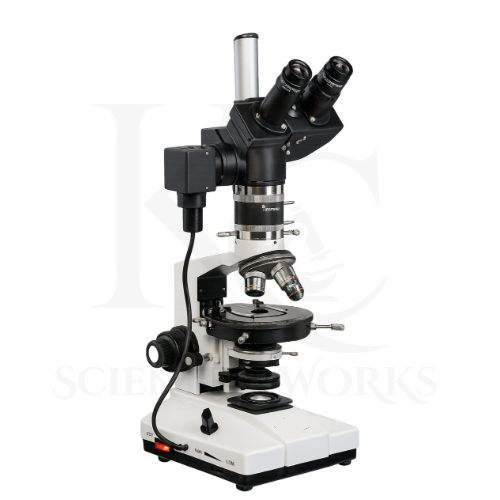
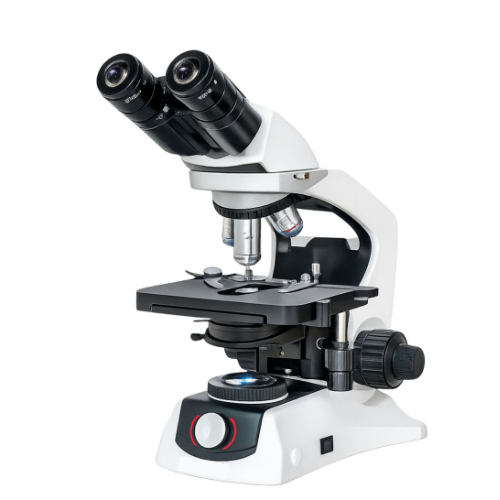
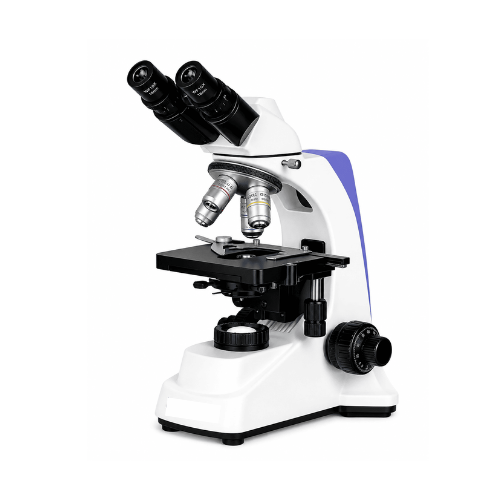
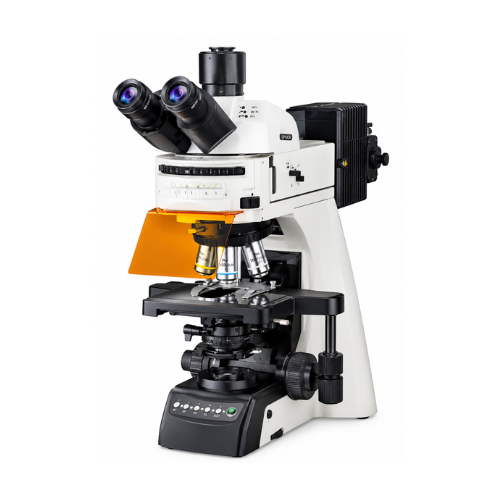
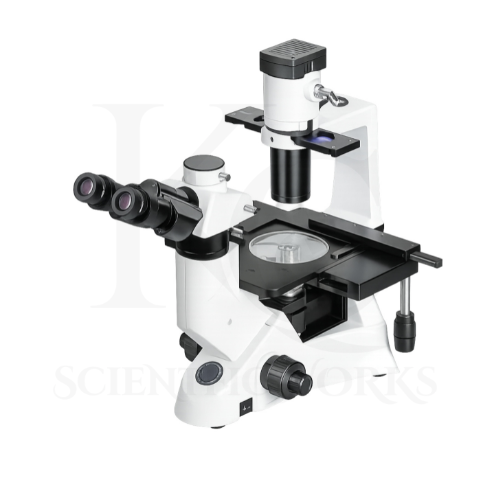
The Polarizing Trinocular Microscope KCX-123 is designed for optical examination of suitable ore specimens, opaque minerals, geological samples and other materials.
It supports both incident and transmitted illumination.
Incident illumination is useful for examining opaque specimens because light is directed onto the specimen surface and reflected toward the observation optics.
Transmitted illumination is useful for examining compatible transparent specimens and prepared thin sections.
The microscope incorporates a graduated polarizer, sliding analyzer and rotating circular stage for polarized-light observation.
These components allow users to examine suitable optical characteristics, including anisotropy and polarization-dependent changes in specimen appearance.
The half-wave and quarter-wave compensators support additional optical studies.
The Bertrand lens provides an accessory for suitable advanced polarization observation.
The trinocular head supports visual observation and compatible digital image documentation.
The KCX-123 is intended for ore microscopy, geological laboratory instruction, mineralogy, materials science and appropriate metallurgical inspection.
Applications
1. Ore Mineral Identification
The KCX-123 Polarizing Trinocular Microscope supports examination of suitable opaque ore minerals.
2. Geological Laboratory Analysis
The microscope can be used for observation of prepared geological specimens.
3. Metallurgical Microstructure Examination
The KCX-123 supports optical inspection of suitable polished metallurgical samples.
4. Materials Science Research
The microscope can be used for appropriate observation of reflective and transparent material specimens.
5. Educational Ore Microscopy
The microscope supports training in ore microscopy principles.
6. Mineralogy Laboratories
The KCX-123 can be used for suitable mineral specimen examination.
7. Geological Thin-Section Observation
Transmitted-light observation supports examination of compatible geological thin sections.
8. Polished Ore Section Examination
Incident-light observation supports examination of suitable polished ore specimens.
9. Crystallography Education
The microscope supports instructional studies of polarized light and suitable crystalline materials.
10. Metallurgical Laboratories
The KCX-123 can support appropriate laboratory microscopy involving metal specimens.
11. Mining Research Laboratories
The microscope can be used for examination of suitable ore and geological samples.
12. Mineral Processing Laboratories
The KCX-123 can support optical observation of suitable prepared mineral samples.
13. Industrial Mineral Quality Assessment
The microscope can assist with appropriate optical examination of mineral texture and structure.
14. University Geology Departments
The microscope supports practical teaching in geology and mineralogy.
15. Research Institutions
The KCX-123 can be used for suitable optical microscopy research.
16. Optical Anisotropy Studies
The microscope supports observation of polarization-dependent optical behavior.
17. Rock and Mineral Texture Examination
The microscope can assist in observing suitable mineral textures and structural features.
18. Scientific Laboratory Training
The KCX-123 supports instruction in polarizer, analyzer and compensator operation.
19. Digital Microscopy Documentation
The trinocular configuration can support specimen image capture using compatible equipment.
20. Geological and Industrial Microscopy Workshops
The microscope is suitable for instructor-led microscopy demonstrations and practical training.
Typical Specimens and Observations
| Specimen | Observation Purpose |
|---|
| Polished Ore Sections | Reflected-light mineral observation |
| Opaque Minerals | Surface and optical characteristic examination |
| Geological Thin Sections | Transmitted-light mineral examination |
| Metal Specimens | Microstructure inspection |
| Crystalline Materials | Polarization-dependent optical studies |
| Mineral Grains | Optical identification training |
| Rock Samples | Geological texture examination |
| Reflective Materials | Incident-light observation |
| Transparent Mineral Sections | Transmitted polarized-light observation |
| Industrial Material Samples | Appropriate optical inspection |
| Prepared Geological Slides | Educational microscopy |
| Laboratory Research Specimens | Scientific observation |
Working Principle
The Polarizing Trinocular Microscope KCX-123 operates using incident-light and transmitted-light microscopy combined with polarized-light observation.
Transmitted-Light Operation
In transmitted-light observation, illumination passes through a suitable transparent or thin specimen.
The polarizer selects a polarization orientation for the incident light.
When the light passes through an optically anisotropic specimen, its polarization state can change.
The analyzer allows these changes to produce visible contrast and, under appropriate conditions, interference effects.
The graduated circular stage allows the specimen to be rotated during examination.
Incident-Light Operation
In incident-light observation, illumination is directed onto the surface of an opaque or reflective specimen.
The reflected light enters the microscope's observation optics.
Suitable ore minerals and polished material surfaces can be examined according to their reflected-light characteristics.
Where the incident-light optical path incorporates appropriate polarizing components, polarization-dependent effects may also be examined.
Compensators and Bertrand Lens
The half-wave and quarter-wave compensators support additional polarization studies.
The Bertrand lens supports suitable advanced optical observation when the required illumination and optical arrangements are established.
The microscope's coaxial focusing system is used to obtain a clear specimen image.
Basic Observation Procedure
Microscope Setup: Position the KCX-123 on a stable laboratory bench.
Specimen Selection: Prepare a suitable polished ore section, geological thin section or other compatible sample.
Stage Positioning: Place the specimen on the rotating circular stage.
Illumination Selection: Select incident or transmitted illumination according to specimen properties.
Brightness Adjustment: Adjust the solid-state light control.
Objective Selection: Begin with a lower-power objective.
Focusing: Use the coaxial focusing controls to obtain a clear image.
Polarizer Adjustment: Insert or adjust the polarizer when required.
Analyzer Selection: Use the sliding analyzer for suitable polarized-light observation.
Stage Rotation: Rotate the specimen stage to examine changes in optical appearance.
Compensator Use: Insert the required wave compensator for appropriate optical studies.
Bertrand Lens Use: Use the Bertrand lens where the observation method requires it.
Image Documentation: Capture images through the trinocular port using compatible camera equipment when installed.
Completion: Return the microscope to a suitable resting configuration and switch off the illumination.
Magnification System
The KCX-123 includes 5X and 10X eyepieces, with an optional 15X eyepiece.
The supplied objective list includes P5X, P10X and either P40X or P45X.
| Objective | 5X Eyepiece | 10X Eyepiece | Optional 15X Eyepiece |
|---|
| P5X | 25X | 50X | 75X |
| P10X | 50X | 100X | 150X |
| P40X | 200X | 400X | 600X |
| P45X | 225X | 450X | 675X |
With P40X configuration: Maximum nominal magnification is 400X using the 10X eyepiece, or 600X with the optional 15X eyepiece.
With P45X configuration: Maximum nominal magnification is 450X using the 10X eyepiece, or 675X with the optional 15X eyepiece.
The actual magnification range depends on the installed objective and eyepiece configuration.
Optical System and Eyepieces
| Parameter | Specification |
|---|
| Observation Head | Trinocular |
| Eyepiece 1 | 5X Cross |
| Eyepiece 2 | 10X Ocular |
| Optional Eyepiece | 15X |
| Objectives | P5X, P10X, P40X / P45X |
| Observation Modes | Incident and Transmitted Light |
| Polarizing System | Provided |
| Camera Port | Trinocular |
Polarizer and Analyzer System
The microscope incorporates a graduated polarizer and sliding analyzer for polarized-light observation.
Polarization Specifications
| Parameter | Specification |
|---|
| Polarizer | Fully Graduated |
| Polarizer Mechanism | In–Out |
| Analyzer | Sliding |
| Half-Wave Compensator | Included |
| Quarter-Wave Compensator | Included |
| Bertrand Lens | Provided |
| Stage Rotation | 0–360° |
| Stage Graduation | Vernier |
Rotating Circular Stage
The KCX-123 features a circular rotating stage for specimen positioning.
Its vernier graduation supports angular observation during suitable optical studies.
Stage Specifications
| Parameter | Specification |
|---|
| Stage Type | Circular Rotating |
| Rotation | 0–360° |
| Graduation | Vernier |
| Stage Diameter | Not Specified |
| Primary Function | Specimen Orientation and Rotation |
Condenser System
The microscope incorporates an adjustable condenser for transmitted-light observation.
Condenser Specifications
| Parameter | Specification |
|---|
| Condenser Type | Adjustable |
| Numerical Aperture | 1.25 |
| Primary Function | Transmitted-Light Illumination Control |
| Condenser Adjustment | Available |
Focusing System
The KCX-123 incorporates coaxial focusing controls for adjusting specimen focus.
Focusing Specifications
| Parameter | Specification |
|---|
| Focusing System | Coaxial |
| Fine Focusing Division | Not Specified |
| Focusing Travel | Not Specified |
| Primary Function | Image Focusing |
Illumination System
The microscope supports incident and transmitted illumination modes.
The reference specifies a built-in halogen light source with solid-state light control.
Illumination Specifications
| Parameter | Specification |
|---|
| Illumination Modes | Incident and Transmitted |
| Light Source | Halogen |
| Lamp Rating | 6V / 20W |
| Brightness Control | Solid-State |
| Power Supply | 230V AC |
| Separate Incident-Light Lamp Rating | Not Specified |
| Separate Transmitted-Light Lamp Rating | Not Specified |
Half-Wave and Quarter-Wave Compensators
The KCX-123 includes wave compensators for suitable polarized-light studies.
Half-Wave Compensator
A half-wave compensator introduces approximately half a wavelength of relative phase retardation under its specified operating conditions.
It can be used for instructional demonstrations involving polarization changes.
Quarter-Wave Compensator
A quarter-wave compensator introduces approximately one-quarter wavelength of relative phase retardation under its specified operating conditions.
It supports demonstrations involving optical retardation and polarization state changes.
Digital Imaging Compatibility
The KCX-123 incorporates a trinocular observation head.
This arrangement can support digital microscope imaging when an appropriate camera and optical adapter are installed.
Imaging Specifications
| Parameter | Specification |
|---|
| Observation Head | Trinocular |
| Camera Port | Trinocular Observation Path |
| Digital Camera Compatibility | Subject to Suitable Adapter |
| Camera Resolution | Not Specified |
| Camera Interface | Not Specified |
| Imaging Software | Not Specified |
| Camera Included | Not Confirmed |
Educational and Research Benefits
The KCX-123 Polarizing Trinocular Microscope supports education and research involving:
Ore microscopy
Opaque mineral observation
Geological specimen examination
Mineral identification training
Incident-light microscopy
Transmitted-light microscopy
Polarized-light microscopy
Metallurgical specimen observation
Mineral texture studies
Optical anisotropy
Stage rotation and angular measurement
Analyzer operation
Polarizer adjustment
Half-wave compensator studies
Quarter-wave compensator studies
Bertrand lens demonstrations
Trinocular image documentation
Scientific laboratory training
Microscope Compatibility and Usage
The KCX-123 Polarizing Trinocular Microscope is intended for appropriate ore, geological and materials microscopy applications.
It can be used in geological laboratories, mineralogy departments, metallurgy laboratories, research institutions and educational facilities.
The microscope should be placed on a stable laboratory surface.
Opaque specimens should be prepared appropriately for incident-light observation.
Transparent or thin-section specimens should be prepared for transmitted-light observation.
The illumination mode should be selected according to the specimen.
The graduated polarizer and sliding analyzer can be adjusted for suitable polarized-light examination.
The rotating stage allows changes in specimen orientation to be studied.
The half-wave and quarter-wave compensators may be used for appropriate optical demonstrations.
The Bertrand lens should be used with the correct optical arrangement.
A compatible digital camera may be fitted to the trinocular port when required.
After use, optical surfaces should be cleaned with appropriate optical cleaning materials.
The microscope should be stored in a clean and dry environment.