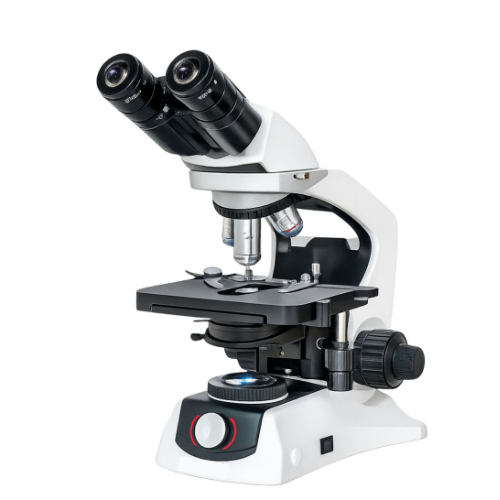
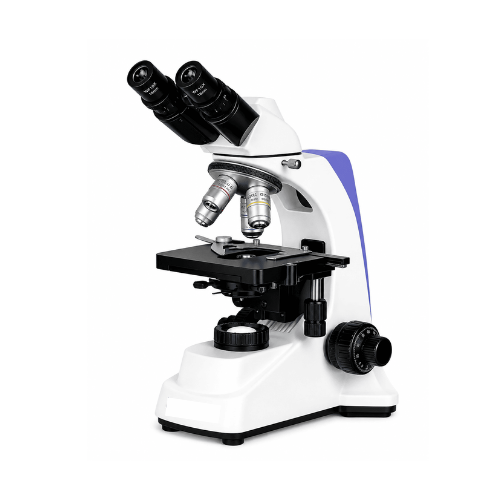
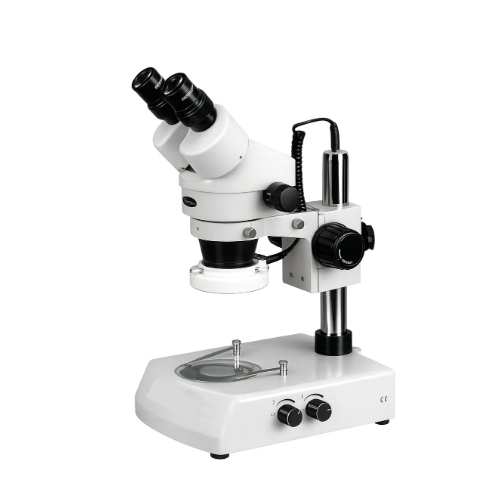
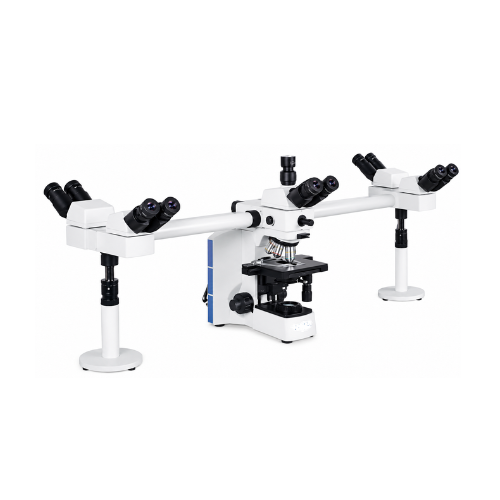
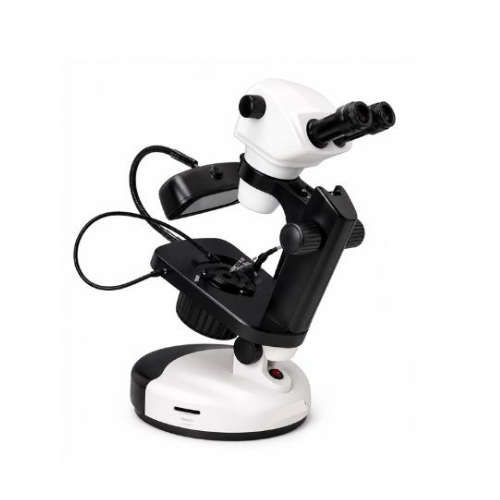
The Research Microscope Max Series KCX-129 is designed for detailed observation of biological specimens, microorganisms, tissue sections, prepared blood smears and other suitable microscope slides.
Its infinity-corrected optical system supports high-quality image formation.
The binocular viewing head provides direct observation through two eyepieces.
The PL10X/22 mm high-eyepoint eyepieces offer a wide viewing field.
The infinity plan achromatic objectives provide magnification options suitable for specimen scanning and detailed examination.
The microscope incorporates 4X, 10X, 40X and 100X objectives.
The 100X oil immersion objective supports high-magnification observation when used with appropriate immersion oil and laboratory procedures.
The large double-layer mechanical stage supports controlled specimen positioning.
The coaxial focusing system allows adjustment of image sharpness.
The Abbe condenser and 3W LED Köhler illumination system support controlled transmitted-light observation.
The KCX-129 is intended for biological laboratories, educational institutions, microbiology laboratories, pathology departments, biotechnology research and appropriate scientific applications.
Applications
1. Clinical Laboratories
The KCX-129 Research Microscope Max Series supports examination of suitable prepared clinical specimens.
2. Pathology Laboratories
The microscope can be used for microscopic observation of prepared pathology slides.
3. Microbiology Laboratories
The KCX-129 supports examination of appropriately prepared microbial specimens.
4. Medical Colleges
The microscope is suitable for teaching biological and medical microscopy.
5. Universities
The KCX-129 supports practical teaching and scientific research.
6. Research Institutes
The microscope can be used for biological specimen examination in research environments.
7. Biotechnology Laboratories
The KCX-129 supports appropriate biotechnology microscopy applications.
8. Pharmaceutical Industries
The microscope can be used for suitable microscopy tasks in pharmaceutical laboratories.
9. Hospitals
The microscope supports laboratory specimen observation in appropriate hospital settings.
10. Veterinary Laboratories
The KCX-129 can be used for examination of suitable prepared veterinary specimens.
11. Quality-Control Laboratories
The microscope supports appropriate microscopic quality-control examinations.
12. Educational Institutions
The KCX-129 is suitable for biological laboratory teaching.
13. Histology Laboratories
The microscope can be used for observation of prepared tissue sections.
14. Hematology Laboratories
The KCX-129 supports examination of appropriately prepared blood smears.
15. Biological Research
The microscope can assist with observation of suitable biological specimens.
16. Cell Biology Laboratories
The microscope supports observation of prepared cellular specimens.
17. Botany Laboratories
The KCX-129 can be used for examination of suitable plant tissues and cells.
18. Zoology Laboratories
The microscope supports observation of prepared animal specimens.
19. Laboratory Training Centers
The KCX-129 supports instruction in biological microscopy techniques.
20. Scientific Research and Development
The microscope can be used for appropriate laboratory research and specimen examination.
Typical Specimens and Observations
| Specimen | Observation Purpose |
|---|
| Prepared Blood Smears | Blood cell morphology observation |
| Histology Slides | Tissue structure examination |
| Prepared Bacterial Smears | Microbial morphology observation |
| Plant Tissue Sections | Botanical structure examination |
| Animal Tissue Sections | Zoological and histological studies |
| Prepared Cell Slides | Cellular structure observation |
| Microbiology Teaching Slides | Educational microbial examination |
| Biological Research Samples | Scientific specimen observation |
| Prepared Veterinary Slides | Veterinary laboratory microscopy |
| Prepared Pharmaceutical Samples | Appropriate laboratory microscopy |
| Educational Slide Collections | Student practical training |
| Stained Tissue Sections | Microscopic tissue examination |
Working Principle
The Research Microscope Max Series KCX-129 operates on the principle of transmitted-light compound microscopy.
Light from the 3W LED illumination system is directed through the condenser toward the specimen.
The Köhler illumination arrangement allows the illumination to be adjusted for controlled specimen lighting.
The specimen is positioned on the double-layer mechanical stage.
Light passing through the specimen enters the selected objective lens.
The objective produces a magnified intermediate image within the infinity-corrected optical system.
The microscope's tube-lens arrangement forms the image that is viewed through the PL10X eyepieces.
Different objective magnifications can be selected using the backward quintuple revolving nosepiece.
The coaxial coarse and fine focusing controls are used to obtain a sharp specimen image.
The mechanical stage allows controlled movement of the slide during examination.
The 100X oil immersion objective is used with appropriate immersion oil and suitable prepared specimens.
This optical arrangement supports detailed biological microscopy across the supplied magnification range.
Basic Observation Procedure
Microscope Setup: Place the KCX-129 on a stable laboratory bench.
Specimen Preparation: Select a suitable prepared microscope slide.
Slide Positioning: Secure the slide on the mechanical stage.
Illumination: Switch on the 3W LED illumination system.
Köhler Adjustment: Adjust the illumination according to the microscope's operating procedure.
Objective Selection: Begin with the 4X objective.
Initial Focusing: Use coarse focusing to locate the specimen.
Fine Focusing: Adjust fine focus for a clear image.
Specimen Movement: Use the mechanical stage controls to examine different areas.
Higher Magnification: Select the 10X or 40X objective when required.
Oil Immersion: Use the 100X objective with suitable immersion oil when appropriate.
Observation: Examine the required specimen structures.
Documentation: Record observations according to laboratory procedures.
Completion: Clean the oil immersion objective correctly after use and switch off the microscope.
Magnification System
The KCX-129 includes PL10X eyepieces with four specified infinity plan achromatic objectives.
| Objective | Eyepiece | Total Magnification |
|---|
| 4X | 10X | 40X |
| 10X | 10X | 100X |
| 40X Spring | 10X | 400X |
| 100X Oil Spring | 10X | 1000X |
Standard nominal magnification range: 40X–1000X.
The quintuple nosepiece has five positions, but only four objective magnifications are specified.
Infinity Optical System
The KCX-129 incorporates an infinity-corrected optical system with plan achromatic objectives.
Optical Specifications
| Parameter | Specification |
|---|
| Optical System | Infinity-Corrected |
| Objective Type | Infinity Plan Achromatic |
| Eyepieces | PL10X/22 mm |
| Eyepiece Design | High Eyepoint |
| Objectives | 4X, 10X, 40X and 100X |
| 40X Objective | Spring-Loaded |
| 100X Objective | Oil Immersion, Spring-Loaded |
| Nosepiece | Backward Quintuple Ball-Bearing |
| Magnification | 40X–1000X |
Binocular Observation System
The KCX-129 features a binocular observation head designed for laboratory use.
Viewing Specifications
| Parameter | Specification |
|---|
| Observation Head | Binocular |
| Inclination | 30° |
| Rotation | 360° |
| Eyepiece Type | PL High-Eyepoint |
| Eyepiece Magnification | 10X |
| Eyepiece Field Number | 22 mm |
| Interpupillary Adjustment | Not Specified |
| Diopter Adjustment | Not Specified |
Mechanical Stage
The microscope features a large double-layer mechanical stage with low-hand controls.
Stage Specifications
| Parameter | Specification |
|---|
| Stage Type | Double-Layer Mechanical |
| Dimensions | 220 × 148 mm |
| Specimen Movement | X-Y |
| Control Position | Low Hand |
| Travel Range | Not Specified |
| Primary Function | Precise Slide Positioning |
Coaxial Focusing System
The KCX-129 incorporates coaxial coarse and fine focusing controls.
Focusing Specifications
| Parameter | Specification |
|---|
| Focusing Type | Coaxial |
| Coarse Focusing | Provided |
| Fine Focusing | Provided |
| Fine Focus Division | Not Specified |
| Focusing Travel | Not Specified |
| Primary Function | Image Sharpness Adjustment |
Condenser System
The microscope incorporates an Abbe condenser with an iris diaphragm.
Condenser Specifications
| Parameter | Specification |
|---|
| Condenser Type | Abbe |
| Iris Diaphragm | Included |
| Numerical Aperture | Not Specified |
| Primary Function | Transmitted-Light Illumination Control |
LED Köhler Illumination System
The KCX-129 features a 3W LED illumination system with Köhler illumination.
Illumination Specifications
| Parameter | Specification |
|---|
| Light Source | LED |
| LED Power | 3W |
| Illumination Method | Köhler |
| Power Supply | AC Powered |
| Voltage Range | Not Specified |
| Primary Purpose | Transmitted-Light Specimen Illumination |
Body Construction and Finish
The microscope features a heavy-duty metal frame with a corrosion-resistant powder-coated finish.
Construction Specifications
| Parameter | Specification |
|---|
| Body Material | Metal |
| Construction | Heavy-Duty |
| Finish | Powder Coated |
| Finish Property | Corrosion Resistant |
| Installation | Laboratory Desktop |
Educational and Research Benefits
The KCX-129 Research Microscope Max Series supports:
Biological specimen examination
Microbiology laboratory observation
Histology studies
Blood smear observation
Cellular morphology studies
Tissue structure examination
Plant cell observation
Animal tissue microscopy
Medical laboratory education
Veterinary laboratory microscopy
Pharmaceutical laboratory applications
Biotechnology research
Scientific laboratory training
Quality-control microscopy
Oil immersion microscopy
Infinity optical system training
Köhler illumination adjustment
Mechanical stage operation
High-magnification biological observation
Microscope Compatibility and Usage
The KCX-129 Research Microscope Max Series is intended for biological, educational, clinical and research laboratory applications.
The microscope should be positioned on a stable laboratory bench.
Prepared slides should be secured on the double-layer mechanical stage.
The LED illumination system should be adjusted according to the specimen and objective.
Observation should begin with the 4X objective.
The coaxial focusing controls should be used carefully.
The mechanical stage allows movement of the specimen during examination.
Higher-power objectives can be selected when required.
The 100X oil immersion objective should be used only with suitable immersion oil and correct laboratory procedures.
The objective should be cleaned appropriately after oil immersion use.
The microscope should be stored in a clean and dry environment.