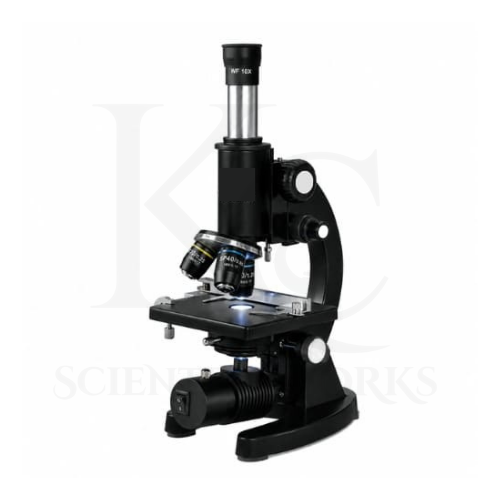
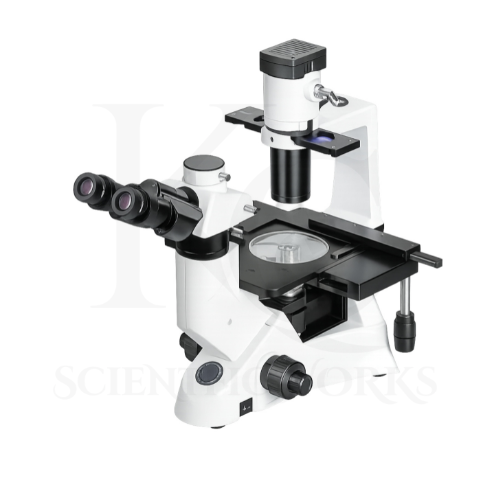
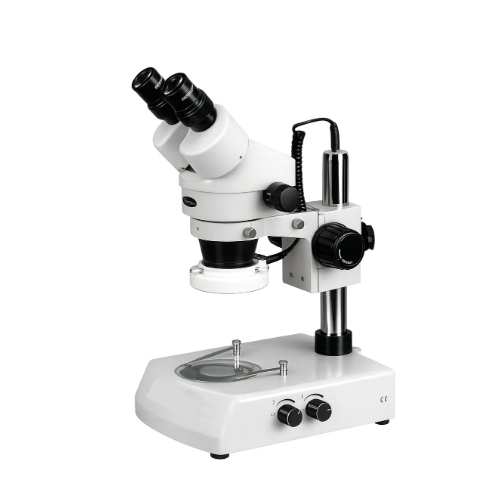
The Simple Medical Microscope KCX-104 is designed for microscopic observation of biological specimens, microorganisms, prepared tissue sections, blood smears and suitable laboratory samples.
Its achromatic objective lenses support specimen observation through a monocular viewing system.
The microscope includes 10X, 40X and 100X oil immersion objectives.
Combined with the WF10X eyepiece, these objectives provide nominal magnifications of 100X, 400X and 1000X.
The coaxial mechanical stage supports controlled movement of prepared specimens.
The coarse and fine rack-and-pinion focusing system allows users to adjust image sharpness.
The Abbe condenser with N.A. 1.25 supports illumination of specimens.
The battery-operated LED light source provides transmitted-light illumination.
The KCX-104 is intended for biological laboratories, medical training institutes, pathology education, microbiology teaching, colleges and suitable routine laboratory microscopy applications.
Applications
1. Medical Education
The KCX-104 Simple Medical Microscope supports practical training in biological and medical microscopy.
2. Biology Laboratories
The microscope can be used for observation of suitable prepared biological specimens.
3. Microbiology Laboratories
The KCX-104 supports examination of appropriately prepared microbial samples.
4. Pathology Training Laboratories
The microscope can be used for educational observation of prepared pathology slides.
5. Hematology Education
The KCX-104 supports examination of properly prepared blood smears.
6. Histology Laboratories
The microscope can be used for observation of prepared tissue sections.
7. Medical Colleges
The KCX-104 supports introductory and practical microscopy instruction.
8. Nursing Institutes
The microscope can assist with educational specimen demonstrations.
9. School Science Laboratories
The KCX-104 supports biological microscopy lessons.
10. College Biology Departments
The microscope is suitable for practical laboratory exercises.
11. Laboratory Technician Training
The KCX-104 supports instruction in microscope handling and focusing.
12. Cell Biology Education
The microscope can be used to examine suitable prepared cellular specimens.
13. Botany Laboratories
The KCX-104 supports observation of prepared plant tissues.
14. Zoology Laboratories
The microscope can be used for examination of prepared animal tissues.
15. Veterinary Education
The KCX-104 supports microscopy demonstrations using suitable veterinary teaching specimens.
16. Biotechnology Education
The microscope can assist with basic biological specimen observation.
17. Scientific Demonstrations
The KCX-104 supports classroom demonstrations of compound microscopy.
18. Prepared Slide Examination
The microscope can be used for routine observation of suitable prepared microscope slides.
19. Laboratory Training Programs
The KCX-104 supports training in objective selection, focusing and specimen positioning.
20. General Biological Observation
The microscope is suitable for appropriate transmitted-light specimen examination.
Typical Specimens and Observations
| Specimen | Observation Purpose |
|---|
| Prepared Blood Smears | Blood cell morphology observation |
| Prepared Bacterial Smears | Microbial morphology observation |
| Histology Slides | Tissue structure examination |
| Plant Tissue Sections | Botanical structure observation |
| Animal Tissue Sections | Zoological studies |
| Prepared Cell Slides | Cellular structure observation |
| Microbiology Teaching Slides | Educational microbial examination |
| Prepared Veterinary Slides | Veterinary microscopy training |
| Educational Specimen Slides | Biology laboratory instruction |
| Prepared Laboratory Samples | Routine microscopic examination |
Working Principle
The Simple Medical Microscope KCX-104 operates on the principle of transmitted-light compound microscopy.
Light from the battery-operated LED illumination system is directed upward through the condenser.
The Abbe condenser concentrates light toward the prepared specimen.
Light passing through the specimen enters the selected achromatic objective.
The objective forms a magnified intermediate image.
The WF10X eyepiece further magnifies the image for direct observation.
The triple revolving nosepiece allows selection of the 10X, 40X or 100X objective.
The coaxial mechanical stage supports movement of the specimen in the X and Y directions.
The rack-and-pinion focusing system allows coarse and fine adjustment of image sharpness.
For appropriate high-magnification examination, the 100X objective is used with suitable immersion oil.
Basic Observation Procedure
Microscope Setup: Place the KCX-104 on a stable laboratory bench.
Battery Check: Ensure suitable batteries are installed according to the operating instructions.
Specimen Preparation: Select an appropriate prepared microscope slide.
Slide Positioning: Position the slide on the mechanical stage.
Illumination: Switch on the LED illumination system.
Objective Selection: Begin with the 10X objective.
Initial Focusing: Use coarse focusing to locate the specimen.
Fine Focusing: Adjust the fine focusing control for image clarity.
Stage Movement: Use the mechanical stage controls to examine different specimen areas.
Higher Magnification: Select the 40X objective when required.
Oil Immersion: Use the 100X objective with appropriate immersion oil when necessary.
Observation: Examine the relevant specimen characteristics.
Completion: Clean the oil immersion objective correctly after use.
Storage: Switch off the microscope and store it in a clean, dry location.
Magnification System
The KCX-104 includes a WF10X eyepiece and three achromatic objectives.
Total Magnification = Eyepiece Magnification × Objective Magnification
| Objective | Eyepiece | Total Magnification |
|---|
| 10X | 10X | 100X |
| 40X | 10X | 400X |
| 100X Oil Immersion | 10X | 1000X |
Magnifications supported by the listed optics: 100X, 400X and 1000X.
The supplied reference states a magnification range of 40X–1000X. Achieving 40X with a 10X eyepiece would require a 4X objective, which is not included in the listed three-objective configuration.
Achromatic Optical System
The KCX-104 features achromatic objective lenses for biological specimen observation.
Optical Specifications
| Parameter | Specification |
|---|
| Optical System | Achromatic |
| Viewing Head | Monocular |
| Eyepiece | Extra Wide Field WF10X |
| Objectives | 10X, 40X and 100X Oil |
| Nosepiece | Triple Revolving |
| Maximum Nominal Magnification | 1000X |
Achromatic objectives are designed to reduce selected chromatic aberrations.
The optical quality and resolving power depend on objective specifications, illumination and specimen preparation.
Monocular Viewing System
The KCX-104 incorporates a monocular viewing head.
Viewing Specifications
| Parameter | Specification |
|---|
| Viewing Head | Monocular |
| Eyepiece | WF10X |
| Viewing Method | Direct Optical Observation |
| Head Inclination | Not Specified |
| Head Rotation | Not Specified |
| Camera Port | Not Specified |
Triple Revolving Nosepiece
The microscope incorporates a three-position revolving nosepiece.
Nosepiece Specifications
| Parameter | Specification |
|---|
| Nosepiece Type | Triple Revolving |
| Objective Positions | 3 |
| Specified Objectives | 10X, 40X and 100X Oil |
| Primary Function | Objective Selection |
Coaxial Mechanical Stage
The KCX-104 features a mechanical stage for controlled slide positioning.
Stage Specifications
| Parameter | Specification |
|---|
| Stage Type | Coaxial Mechanical |
| Movement | X-Y |
| Stage Dimensions | Not Specified |
| X-Axis Travel | Not Specified |
| Y-Axis Travel | Not Specified |
| Primary Function | Controlled Specimen Movement |
Coarse and Fine Focusing System
The microscope incorporates rack-and-pinion focusing controls.
Focusing Specifications
| Parameter | Specification |
|---|
| Focusing Type | Coarse and Fine |
| Mechanism | Rack and Pinion |
| Fine Focus Division | Not Specified |
| Focusing Travel | Not Specified |
| Primary Function | Image Sharpness Adjustment |
Abbe Condenser System
The KCX-104 incorporates an Abbe condenser with N.A. 1.25.
Condenser Specifications
| Parameter | Specification |
|---|
| Condenser Type | Abbe |
| Numerical Aperture | 1.25 |
| Iris Diaphragm | Not Specified |
| Filter Holder | Not Specified |
| Primary Function | Transmitted-Light Illumination |
Battery-Operated LED Illumination
The KCX-104 features a battery-operated LED illumination system.
Illumination Specifications
| Parameter | Specification |
|---|
| Light Source | LED |
| Power Source | Battery |
| Illumination Method | Transmitted Light |
| LED Wattage | Not Specified |
| Brightness Control | Not Specified |
| Battery Type | Not Specified |
Heavy-Duty Metal Construction
The microscope incorporates a metal body for educational and laboratory applications.
Construction Specifications
| Parameter | Specification |
|---|
| Body Material | Heavy-Duty Metal |
| Viewing Arrangement | Monocular |
| Microscope Design | Compound |
| Power Source | Battery Operated |
| Surface Finish | Not Specified |
| Dimensions | Not Specified |
| Weight | Not Specified |
Educational and Laboratory Benefits
The KCX-104 Simple Medical Microscope supports:
Biological specimen observation
Medical microscopy education
Microbiology demonstrations
Pathology training
Histology studies
Prepared blood smear examination
Cell biology education
Plant tissue observation
Animal tissue examination
Medical college practicals
Nursing laboratory training
School biology experiments
College laboratory instruction
Laboratory technician training
Oil immersion microscopy
Achromatic objective training
Mechanical stage operation
Coarse and fine focusing
Battery-operated LED microscopy
Scientific specimen demonstrations
Microscope Compatibility and Usage
The KCX-104 Simple Medical Microscope is designed for medical education, biological specimen examination and suitable laboratory microscopy.
The microscope should be placed on a stable laboratory surface.
Prepared slides should be positioned correctly on the mechanical stage.
The LED illumination should be switched on before observation.
The 10X objective should be used for initial focusing.
The coarse and fine focusing controls should be adjusted carefully.
The mechanical stage allows controlled movement of the specimen.
The 40X objective can be selected for higher-magnification observation.
The 100X oil immersion objective should be used with appropriate immersion oil.
The objective should be cleaned correctly after oil immersion use.
After observation, the microscope should be switched off and stored in a clean, dry environment.
For clinical diagnostic applications, suitability and laboratory validation should be confirmed separately.