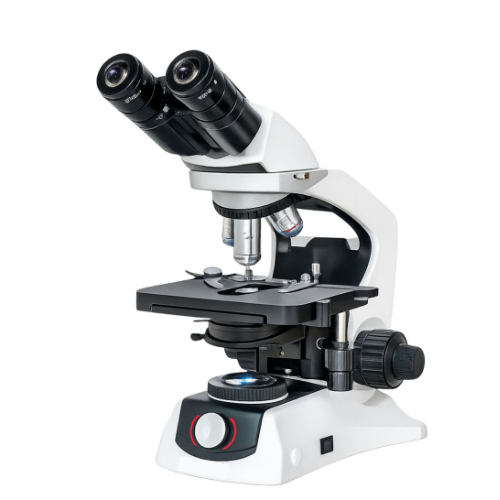
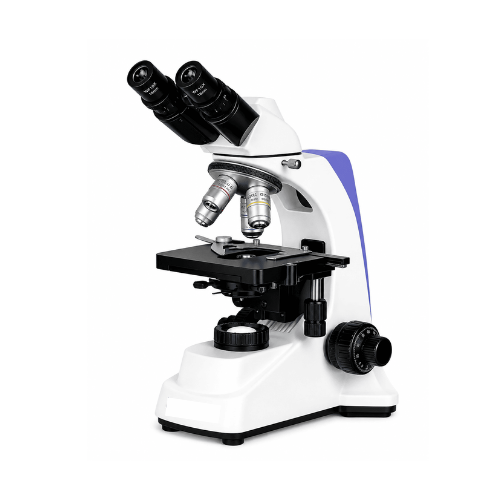
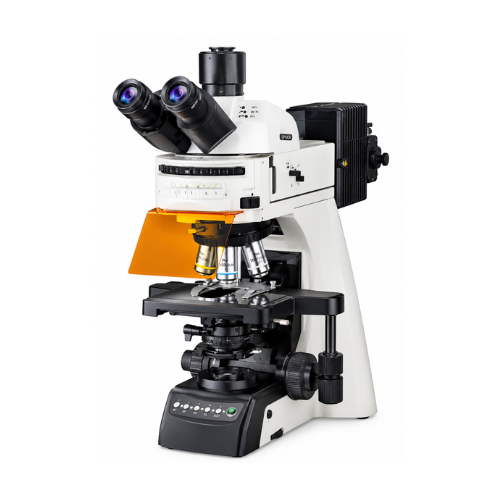
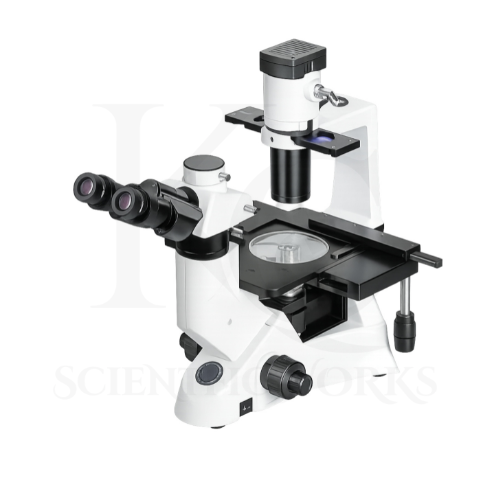
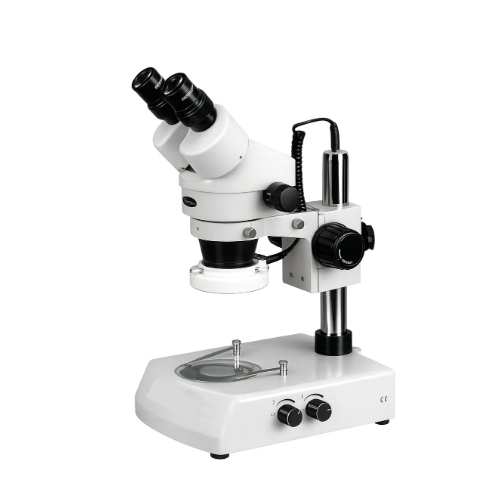
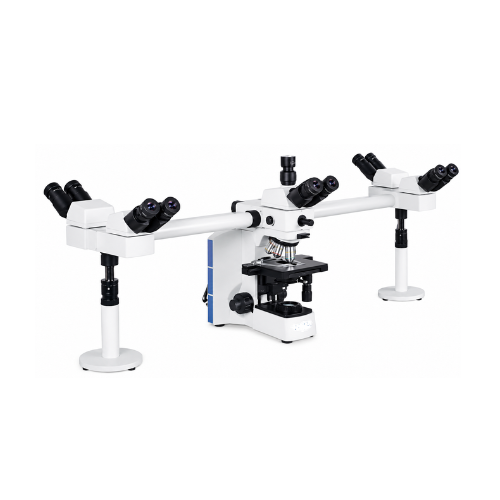
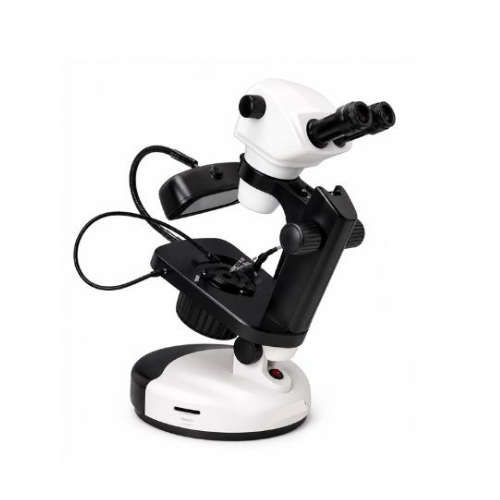
The Stereo Zoom Microscope KCX-186 is designed for detailed three-dimensional observation of small objects, electronic components, biological specimens and manufactured materials.
Its binocular stereoscopic optical system provides separate optical viewing paths for the observer's left and right eyes.
This supports depth perception and makes the microscope useful for examining surface structures.
The 45° inclined binocular head allows convenient viewing.
The adjustable interpupillary distance accommodates different observers.
The interchangeable objective arrangement provides different magnification settings.
The 50 mm working distance allows space between the objective and specimen.
The rack-and-pinion focusing mechanism supports image adjustment.
The reflected LED illumination system supports observation of opaque specimens.
The transmitted LED illumination system supports observation of suitable transparent samples.
The KCX-186 is intended for electronics inspection, PCB examination, quality control, scientific education, biological observation and suitable industrial research applications.
Applications
1. PCB Inspection
The KCX-186 Stereo Zoom Microscope supports visual examination of printed circuit boards and component arrangements.
2. Electronics Testing
The microscope can be used for visual inspection of small electronic components.
3. Circuit Board Assembly
The KCX-186 supports examination of suitable electronic assemblies.
4. Electronics Repair
The microscope can assist with visual inspection during appropriate repair tasks.
5. Industrial Quality Control
The KCX-186 supports surface examination of suitable manufactured products.
6. Manufacturing Inspection
The microscope can be used to inspect small industrial components.
7. Precision Engineering
The KCX-186 supports examination of small precision-engineered parts.
8. Jewellery Inspection
The microscope can be used for visual examination of jewellery surfaces.
9. Gemstone Examination
The KCX-186 supports observation of suitable gemstone features.
10. Watch Component Inspection
The microscope can assist with examination of small watch components.
11. Biological Research
The KCX-186 supports stereoscopic observation of suitable biological specimens.
12. Botany Laboratories
The microscope can be used to examine plant surfaces and botanical samples.
13. Entomology Laboratories
The KCX-186 supports examination of insects and their external structures.
14. Material Science Laboratories
The microscope can be used for observation of material surfaces and textures.
15. Educational Laboratories
The KCX-186 supports teaching demonstrations of stereoscopic microscopy.
16. Universities
The microscope can be used for suitable laboratory teaching and research activities.
17. Research Institutes
The KCX-186 supports scientific specimen observation and inspection.
18. Medical Device Inspection
The microscope can assist with visual examination of suitable small medical device components.
19. Product Development Laboratories
The KCX-186 supports visual inspection during research and development.
20. Scientific Demonstrations
The microscope can be used to demonstrate binocular stereoscopic vision and dual illumination.
Typical Specimens and Observations
| Specimen | Observation Purpose |
|---|
| Printed Circuit Boards | PCB surface and component inspection |
| Electronic Components | Small component examination |
| Solder Joints | Visual inspection of joint appearance |
| Mechanical Components | Surface feature observation |
| Jewellery Components | Surface detail examination |
| Gemstones | External feature inspection |
| Watch Components | Precision component observation |
| Insects | External morphology examination |
| Leaves | Plant surface observation |
| Seeds | Shape and texture examination |
| Plastic Components | Molded surface inspection |
| Metal Components | Surface examination |
| Transparent Samples | Transmitted-light observation |
| Opaque Samples | Reflected-light observation |
Working Principle
The Stereo Zoom Microscope KCX-186 operates on the principle of stereoscopic optical microscopy.
A stereoscopic microscope provides separate optical viewing paths for the observer's left and right eyes.
Each eye receives a slightly different view of the specimen.
The observer's visual system combines these views to produce depth perception.
The microscope incorporates interchangeable objectives for selecting magnification.
The 2X objective provides nominal 20X magnification with the WF10X eyepieces.
The 4X objective provides nominal 40X magnification with the WF10X eyepieces.
The rack-and-pinion focusing mechanism allows adjustment of the optical body relative to the specimen.
The reflected LED illumination system directs light onto the surface of opaque objects.
The transmitted LED illumination system directs light through suitable transparent specimens.
The stage plate supports specimen positioning.
This arrangement allows observation of small objects, surfaces and structures in three dimensions.
Basic Observation Procedure
Microscope Setup: Place the KCX-186 on a stable laboratory bench.
Power Connection: Connect the LED illumination system to the appropriate power source.
Specimen Selection: Choose a suitable specimen or component.
Specimen Placement: Position the specimen on the stage plate.
Interpupillary Adjustment: Adjust the binocular head for comfortable viewing.
Illumination Selection: Choose reflected or transmitted illumination.
Initial Magnification: Begin with the lower-power objective.
Initial Focusing: Use the rack-and-pinion focusing control to obtain a clear image.
Specimen Examination: Observe the visible surface or structural features.
Higher Magnification: Select the higher-power objective when required.
Lighting Adjustment: Change the illumination mode according to the specimen.
Observation Recording: Record relevant specimen characteristics.
Completion: Switch off the illumination system.
Storage: Remove the specimen and store the microscope correctly.
Magnification System
The KCX-186 reference specifies paired WF10X eyepieces and interchangeable 2X and 4X objectives.
Total Magnification = Eyepiece Magnification × Objective Magnification
| Objective | Eyepiece | Total Magnification |
|---|
| 2X | 10X | 20X |
| 4X | 10X | 40X |
Alternative Magnification Reference
The supplied specifications also mention a 10X/30X combination.
| Listed Magnification | Eyepiece | Required Objective |
|---|
| 10X | 10X | 1X |
| 30X | 10X | 3X |
The 1X and 3X objectives are mathematically implied by the alternative magnification combination but are not explicitly listed as supplied objectives.
The reference does not specify a continuously variable zoom ratio.
Stereoscopic Optical System
The KCX-186 features a binocular stereoscopic optical system.
Optical Specifications
| Parameter | Specification |
|---|
| Optical System | Stereoscopic |
| Viewing Head | Binocular |
| Eyepieces | Paired WF10X |
| Field Specification | 18 mm |
| Objectives | Interchangeable 2X and 4X |
| Magnification | 20X and 40X |
| Alternative Magnification | 10X and 30X |
| Continuous Zoom Ratio | Not Specified |
Binocular Viewing System
The microscope incorporates a 45° inclined binocular head.
Viewing Specifications
| Parameter | Specification |
|---|
| Head Type | Binocular |
| Inclination | 45° |
| Interpupillary Distance | 48–75 mm |
| Eyepieces | WF10X |
| Field Specification | 18 mm |
| Diopter Adjustment | Not Specified |
| Camera Port | Not Specified |
Interchangeable Objective System
The KCX-186 incorporates interchangeable objectives.
Objective Specifications
| Parameter | Specification |
|---|
| Standard Listed Objectives | 2X and 4X |
| Objective Change | Interchangeable |
| Magnification with WF10X | 20X and 40X |
| Alternative Objectives | Not Explicitly Specified |
| Continuous Zoom Mechanism | Not Specified |
Working Distance
The microscope features a specified 50 mm working distance.
Working Distance Specifications
| Parameter | Specification |
|---|
| Working Distance | 50 mm |
| Objective Configuration | Not Clarified |
| Primary Function | Clearance Between Objective and Specimen |
The working distance should be confirmed for each objective configuration when preparing a formal technical compliance document.
Rack-and-Pinion Focusing System
The KCX-186 features a rack-and-pinion focusing mechanism.
Focusing Specifications
| Parameter | Specification |
|---|
| Focusing Type | Rack and Pinion |
| Fine Focus Control | Not Specified |
| Focusing Travel | Not Specified |
| Primary Function | Image Sharpness Adjustment |
Stage and Specimen Holding
The microscope incorporates a stage plate with specimen clips.
Stage Specifications
| Parameter | Specification |
|---|
| Stage Type | Stage Plate |
| Specimen Holding | Clips |
| Stage Dimensions | Not Specified |
| Mechanical X-Y Movement | Not Specified |
| Primary Function | Specimen Support |
Dual LED Illumination
The KCX-186 incorporates reflected and transmitted LED illumination.
Illumination Specifications
| Parameter | Specification |
|---|
| Light Source | LED |
| Reflected Illumination | Provided |
| Transmitted Illumination | Provided |
| LED Wattage | Not Specified |
| Brightness Control | Not Specified |
| Simultaneous Operation | Not Specified |
| Power Input | Not Specified |
Reflected Illumination
Reflected illumination directs light onto the specimen surface from above.
It is suitable for examining opaque objects, electronic components and manufactured parts.
Transmitted Illumination
Transmitted illumination directs light through suitable transparent specimens from below.
It supports observation of thin and transparent samples.
Heavy-Duty Metal Construction
The microscope features a metal body.
Construction Specifications
| Parameter | Specification |
|---|
| Body Material | Heavy-Duty Metal |
| Viewing Head | Binocular |
| Microscope Design | Stereoscopic |
| Focusing | Rack and Pinion |
| Illumination | Dual LED |
| Dimensions | Not Specified |
| Weight | Not Specified |
Educational and Industrial Benefits
The KCX-186 Stereo Zoom Microscope supports:
Three-dimensional specimen observation
PCB inspection
Electronic component examination
Circuit board assembly inspection
Industrial quality control
Precision component observation
Jewellery surface inspection
Gemstone examination
Watch component observation
Material surface studies
Biological specimen observation
Insect morphology examination
Botanical specimen studies
Engineering laboratory inspection
Manufacturing quality checks
Research laboratory observation
Educational demonstrations
Reflected-light microscopy
Transmitted-light microscopy
Stereoscopic microscope training
Microscope Compatibility and Usage
The KCX-186 Stereo Zoom Microscope is designed for suitable industrial inspection, biological observation, scientific education and research applications.
The microscope should be placed on a stable surface.
The specimen should be positioned correctly on the stage plate.
The binocular head should be adjusted for comfortable viewing.
Reflected illumination should be selected for opaque specimen surfaces.
Transmitted illumination can be used for suitable transparent specimens.
The rack-and-pinion focusing control should be adjusted carefully.
The appropriate objective should be selected according to the required magnification.
The microscope should be cleaned after use and stored in a dry environment.