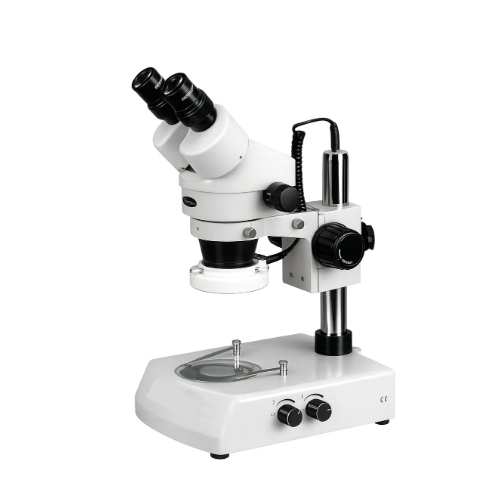
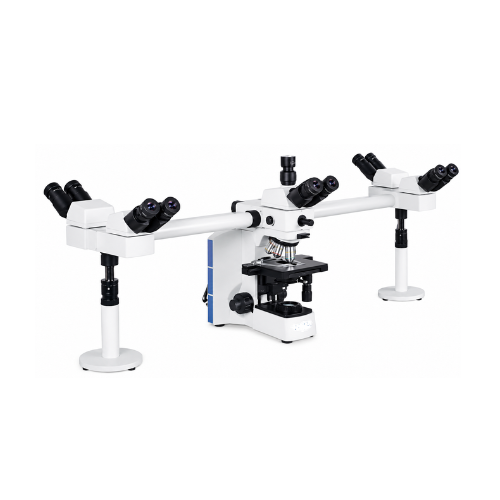
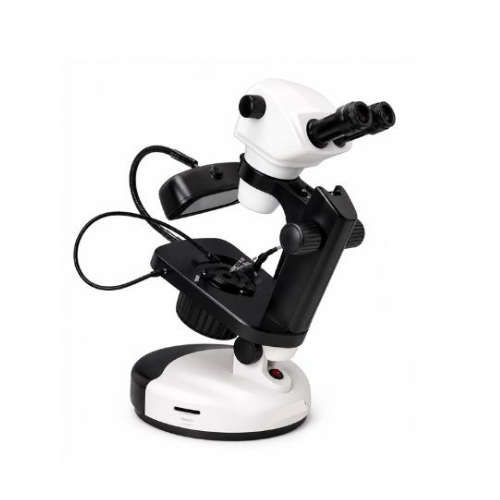
The Stereo Zoom Microscope with Stand KCX-190 is designed for three-dimensional observation of small objects, manufactured components, biological specimens and industrial materials.
Its Greenough stereoscopic optical system provides separate optical viewing paths for the observer's left and right eyes.
This produces depth perception and supports examination of surface structures.
The continuously variable 0.7X–4.5X zoom objectives allow magnification adjustment without changing objective lenses.
Combined with the 10X eyepieces, the microscope provides nominal magnification from 7X to 45X.
The trinocular photo port supports compatible camera attachment for digital specimen imaging.
The double-arm boom stand allows flexible positioning of the microscope head over suitable workpieces.
The 100 mm native working distance provides space between the objective and specimen.
The KCX-190 is intended for industrial quality control, electronics inspection, precision engineering, scientific research, biological observation and laboratory training.
Applications
1. Industrial Quality Control
The KCX-190 Stereo Zoom Microscope with Stand supports visual inspection of suitable manufactured components.
2. PCB Inspection
The microscope can be used for examining printed circuit boards and component arrangements.
3. Electronics Manufacturing
The KCX-190 supports visual inspection during electronics assembly workflows.
4. Electronics Repair
The microscope can assist with visual examination of small electronic components during repair.
5. Precision Engineering
The KCX-190 supports inspection of small precision-engineered parts.
6. Mechanical Component Inspection
The microscope can be used to examine surface details of small mechanical components.
7. Jewellery Inspection
The KCX-190 supports examination of jewellery surfaces and decorative components.
8. Engraving Inspection
The microscope can be used to examine fine engraving details and surface patterns.
9. Watch Component Examination
The KCX-190 supports visual inspection of small watch components.
10. Material Science Laboratories
The microscope can be used for examination of suitable material surfaces and textures.
11. Biological Research
The KCX-190 supports stereoscopic observation of suitable biological specimens.
12. Entomology Laboratories
The microscope can be used to examine insect morphology and external structures.
13. Botany Laboratories
The KCX-190 supports observation of plant surfaces, seeds and suitable botanical specimens.
14. Educational Laboratories
The microscope can be used for teaching stereoscopic microscopy principles.
15. Universities
The KCX-190 supports laboratory teaching and suitable scientific research activities.
16. Research Institutes
The microscope can be used for detailed visual specimen examination.
17. Manufacturing Inspection
The KCX-190 supports inspection of small manufactured products and assemblies.
18. Medical Device Component Inspection
The microscope can assist with visual examination of suitable medical device components.
19. Research and Development
The KCX-190 supports visual inspection during product development and research.
20. Digital Microscopy Documentation
The trinocular photo port supports digital imaging when compatible camera equipment is installed.
Typical Specimens and Observations
| Specimen | Observation Purpose |
|---|
| Printed Circuit Boards | Component and solder joint inspection |
| Electronic Components | Surface and assembly examination |
| Mechanical Parts | Precision component inspection |
| Jewellery | Surface detail examination |
| Engraved Components | Pattern and engraving inspection |
| Watch Parts | Small component observation |
| Insects | External morphology studies |
| Plant Specimens | Botanical surface observation |
| Mineral Samples | Surface texture examination |
| Plastic Components | Molded surface inspection |
| Metal Components | Surface defect observation |
| Precision Assemblies | Assembly quality inspection |
| Research Specimens | Three-dimensional observation |
Working Principle
The Stereo Zoom Microscope with Stand KCX-190 operates on the principle of Greenough stereoscopic microscopy.
The microscope contains separate optical viewing paths for the observer's left and right eyes.
Each optical path provides a slightly different perspective of the specimen.
The observer's visual system combines these images to produce depth perception.
The continuously variable 0.7X–4.5X zoom objectives allow magnification adjustment.
The 10X eyepieces further magnify the optical image.
The microscope provides nominal magnification from 7X to 45X.
The double-arm boom stand allows the optical head to be positioned over the specimen.
The focusing rack provides adjustment of the microscope head relative to the specimen.
The trinocular photo port supports compatible camera imaging.
When the switchable photo path is activated, the reference design directs light from the left optical path toward the camera.
This arrangement supports stereoscopic observation and digital documentation of suitable specimens.
Basic Observation Procedure
Microscope Setup: Position the KCX-190 boom stand on a stable work surface.
Stand Positioning: Adjust the double-arm boom assembly over the intended work area.
Microscope Head Position: Set the optical head at a suitable viewing position.
Specimen Placement: Position the specimen beneath the objective.
Illumination: Provide suitable external illumination according to the specimen.
Interpupillary Adjustment: Adjust the binocular head to match the observer.
Diopter Adjustment: Set the ocular diopters as required.
Initial Magnification: Begin observation at 0.7X objective zoom.
Initial Focusing: Use the focusing rack to obtain a clear image.
Zoom Adjustment: Increase magnification gradually as required.
Specimen Examination: Observe the surface or structural features.
Camera Attachment: Connect compatible imaging equipment if required.
Photo Port Selection: Activate the photo port according to the microscope's operating instructions.
Observation Recording: Record relevant specimen characteristics.
Completion: Return the boom arm to a safe resting position and cover the microscope.
Magnification System
The KCX-190 incorporates continuously variable zoom objectives from 0.7X to 4.5X.
Total Magnification = Eyepiece Magnification × Objective Zoom Magnification
| Objective Zoom | Eyepiece | Nominal Total Magnification |
|---|
| 0.7X | 10X | 7X |
| 1.0X | 10X | 10X |
| 1.5X | 10X | 15X |
| 2.0X | 10X | 20X |
| 2.5X | 10X | 25X |
| 3.0X | 10X | 30X |
| 3.5X | 10X | 35X |
| 4.0X | 10X | 40X |
| 4.5X | 10X | 45X |
Nominal magnification range: 7X–45X.
The intermediate values illustrate the mathematical relationship between objective zoom and eyepiece magnification; they are not a claim that the zoom dial has precisely those calibrated markings.
Zoom Ratio
Zoom Ratio = Maximum Objective Magnification ÷ Minimum Objective Magnification
4.5 ÷ 0.7 = approximately 6.43:1.
Greenough Stereoscopic Optical System
The KCX-190 features a Greenough stereoscopic optical arrangement.
Optical Specifications
| Parameter | Specification |
|---|
| Optical System | Greenough |
| Observation Head | Trinocular |
| Objective Zoom | 0.7X–4.5X |
| Eyepieces | 10X |
| Nominal Magnification | 7X–45X |
| Native Working Distance | 100 mm |
| Native Field of View | 4.4–28.6 mm |
| Auxiliary Lens Thread | 48 mm |
Objective Numerical Aperture and Resolution
The supplied reference specifies numerical aperture and resolution values at the minimum and maximum objective zoom settings.
| Parameter | At 0.7X | At 4.5X |
|---|
| Objective Numerical Aperture | 0.02 | 0.065 |
| Objective Resolution | 60 lp/mm | 195 lp/mm |
These are reference optical specifications for the stated zoom endpoints.
Trinocular Viewing System
The KCX-190 incorporates a 45° inclined trinocular observation head.
Viewing Specifications
| Parameter | Specification |
|---|
| Viewing Head | Trinocular |
| Inclination | 45° |
| Rotation | 360° |
| Interpupillary Adjustment | 54–76 mm |
| Interpupillary Mechanism | Compensation-Free Gemel |
| Diopter Adjustment | Both Oculars, ±5 |
| Ocular Port Diameter | 30 mm |
| Eyepieces | 10X |
| Photo Port | Height-Adjustable 23 mm Tube |
Trinocular Photo Port and Camera Compatibility
The KCX-190 features a dedicated photo port for compatible camera attachment.
Imaging Specifications
| Parameter | Specification |
|---|
| Photo Port Type | Switchable Trinocular |
| Photo Tube | Height-Adjustable |
| Photo Tube Diameter | 23 mm |
| Optical Path | Left Path Diverted When Selected |
| Camera Adapter | Compatibility Dependent |
| Camera Resolution | Not Specified |
| Camera Interface | Not Specified |
| Camera Included | Not Confirmed |
| Imaging Software | Not Specified |
Digital Imaging Applications
With suitable camera equipment, the microscope can support:
Digital specimen photography
Industrial inspection documentation
Research image recording
Educational demonstrations
Component inspection records
Scientific presentation preparation
Double-Arm Boom Stand
The KCX-190 incorporates a double-arm boom stand with ball-bearing-assisted movement.
Boom Stand Specifications
| Parameter | Specification |
|---|
| Stand Type | Double-Arm Boom |
| Arm Movement | Ball-Bearing Assisted |
| Stand Base | Cast Steel |
| Boom Arm Dimension | 20 Inches |
| Overall Arm Length | 30 Inches |
| Vertical Pillar Height | 17 Inches |
| Base Length | 10.25 Inches |
| Base Width | 8.25 Inches |
| Base Height | 2 Inches |
| Focusing Block Travel | 50 mm |
| Focusing Mechanism | Rack |
Advantages of the Double-Arm Boom Stand
The double-arm boom stand supports lateral movement and flexible positioning of the microscope head.
It can be useful for inspecting workpieces that are larger than a conventional microscope stage.
The pivoting arms allow the microscope head to be moved over different inspection areas.
The cast-steel base provides structural support for the stand.
Working Distance and Field of View
The microscope features a native working distance of 100 mm.
Working Distance Specifications
| Parameter | Specification |
|---|
| Native Working Distance | 100 mm |
| Native Field of View | 4.4–28.6 mm |
| Auxiliary Lens Mount | 48 mm Thread |
| Auxiliary Lenses Included | None |
The actual working distance and field of view may change if compatible auxiliary lenses are installed.
Focusing System
The KCX-190 features a focusing rack integrated with the boom stand.
Focusing Specifications
| Parameter | Specification |
|---|
| Focusing Mechanism | Rack |
| Focusing Block Range | 50 mm |
| Fine Focus Control | Not Specified |
| Primary Function | Optical Head Position Adjustment |
Illumination Requirements
The supplied reference does not specify a built-in illumination system for the KCX-190.
For practical specimen observation, suitable external illumination may be used according to the specimen type.
Opaque industrial components are commonly examined using reflected external lighting.
The type, power and accessories of the illumination system should be confirmed separately if lighting equipment is required.
Packing List
The supplied reference specifies the following items:
| Item | Quantity |
|---|
| Trinocular Stereo Microscope Head | 1 |
| Photo Port Attachment | 1 |
| 10X Eyepieces | Supplied; Exact Count to Confirm |
| Eye Guards | 1 Pair |
| Double-Arm Boom Stand | 1 |
| Focusing Rack | 1 |
| Auxiliary Barlow Lenses | Not Included |
| Digital Camera | Not Specified |
| Illumination System | Not Specified |
Educational and Industrial Benefits
The KCX-190 Stereo Zoom Microscope with Stand supports:
Three-dimensional specimen observation
Continuous zoom microscopy
PCB inspection
Electronic component examination
Industrial quality control
Precision component inspection
Jewellery examination
Engraving inspection
Watch component observation
Material surface studies
Biological specimen examination
Insect morphology studies
Botanical specimen observation
Engineering inspection
Manufacturing quality checks
Research laboratory observation
Educational demonstrations
Digital microscopy documentation
Flexible boom-arm positioning
Scientific inspection and training
Microscope Compatibility and Usage
The KCX-190 Stereo Zoom Microscope with Stand is designed for industrial inspection, biological observation, scientific research and educational applications.
The boom stand should be positioned on a stable work surface.
The microscope head should be adjusted over the specimen.
The binocular viewing system should be set according to the observer's interpupillary distance.
The diopter controls should be adjusted for comfortable viewing.
Observation should begin at lower magnification.
The focusing rack should be adjusted carefully.
The zoom control allows continuous magnification adjustment.
Compatible camera equipment can be connected through the trinocular photo port.
The microscope should be cleaned after use and stored in a dry environment.
The boom arm should be secured in a stable resting position when not in use.