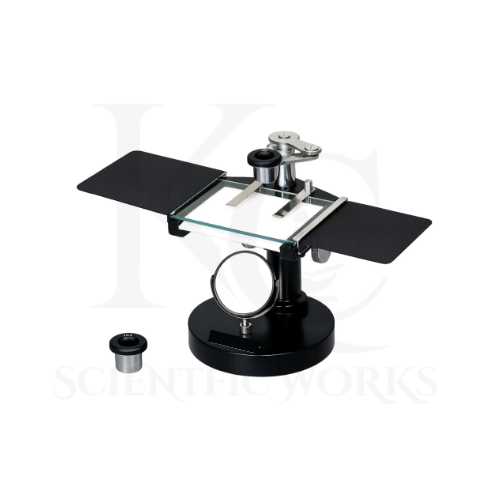
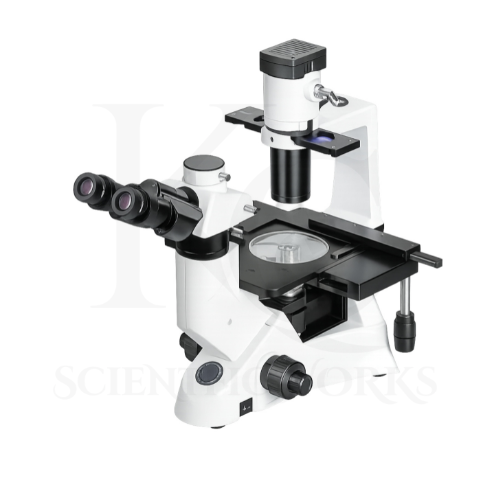
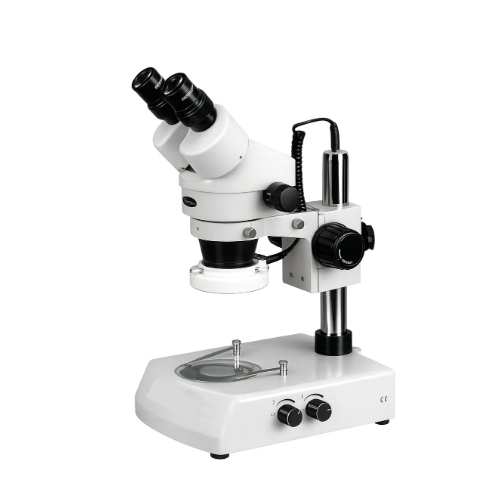
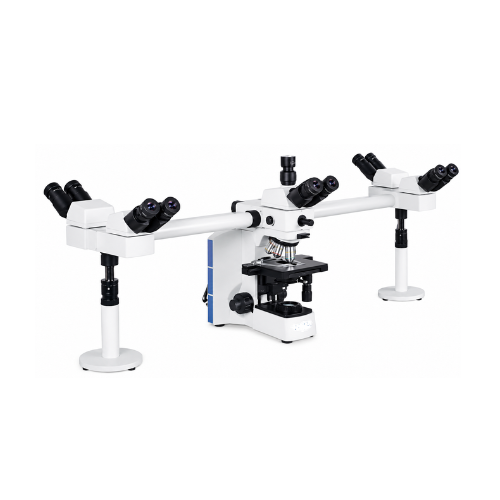
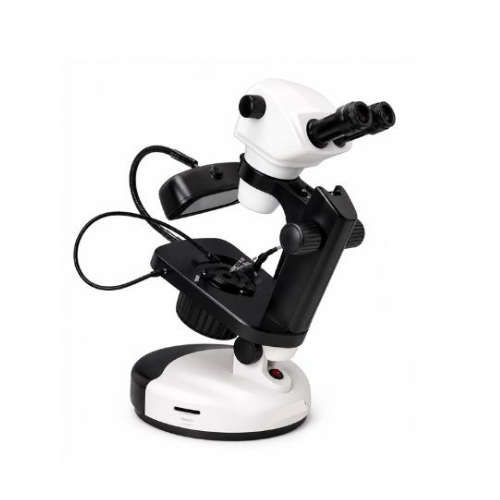
The Student Dissecting Microscope KCX-152 is designed for low-magnification observation of biological specimens, plant structures, insects, small laboratory samples and suitable materials.
Its binocular viewing system allows observation through both eyes.
The interchangeable wide-field eyepieces support the specified magnification range of 10X–20X.
The rack-and-pinion coarse focusing mechanism allows adjustment of image sharpness.
The mirror-based illumination system directs suitable external light toward the specimen.
The large working stage provides space for specimen positioning and observation.
The detachable hand rests provide support during appropriate laboratory activities.
The heavy-duty metal body supports the microscope's structure.
The KCX-152 is intended for school and college biology laboratories, scientific education, botanical studies, entomology, introductory dissection training and suitable research observation.
Applications
1. School Biology Laboratories
The KCX-152 Student Dissecting Microscope supports introductory biological specimen observation.
2. College Zoology Laboratories
The microscope can be used for examination of suitable zoological specimens.
3. Botany Laboratories
The KCX-152 supports observation of plant structures and botanical samples.
4. Entomology Laboratories
The microscope can be used to examine insects and external anatomical features.
5. Educational Dissection Training
The KCX-152 supports supervised introductory dissection activities.
6. Biological Research Laboratories
The microscope can be used for suitable low-magnification specimen examination.
7. Agricultural Laboratories
The KCX-152 supports basic observation of seeds and plant materials.
8. Classroom Science Demonstrations
The microscope can be used to demonstrate biological specimen observation.
9. Plant Structure Examination
The KCX-152 supports examination of leaves, seeds and suitable plant specimens.
10. Insect Morphology Studies
The microscope can be used for observation of insect external structures.
11. Introductory Zoology Education
The KCX-152 supports practical zoological observation exercises.
12. Laboratory Specimen Handling
The microscope provides a working stage for positioning suitable specimens.
13. Biological Sample Comparison
The KCX-152 can be used to compare suitable biological specimens.
14. Science Club Activities
The microscope supports supervised educational observation activities.
15. Student Research Projects
The KCX-152 can assist with suitable biological observation projects.
16. Agricultural Science Education
The microscope supports basic studies of plant and seed morphology.
17. Environmental Science Education
The KCX-152 can be used to examine suitable environmental specimens.
18. Introductory Microscopy Training
The microscope supports learning about binocular viewing, magnification and focusing.
19. Scientific Training Programs
The KCX-152 supports basic laboratory specimen examination training.
20. Educational Laboratory Demonstrations
The microscope can be used for practical demonstrations of low-magnification microscopy.
Typical Specimens and Observations
| Specimen | Observation Purpose |
|---|
| Leaves | External surface and structure examination |
| Seeds | Shape and surface texture observation |
| Plant Stems | External botanical structure examination |
| Flower Parts | Introductory floral morphology studies |
| Insects | External anatomical observation |
| Insect Wings | Wing structure examination |
| Small Biological Specimens | General specimen observation |
| Prepared Tissue Samples | Suitable low-magnification examination |
| Agricultural Seeds | Seed morphology studies |
| Plant Roots | External structure observation |
| Small Laboratory Objects | Surface examination |
| Educational Dissection Specimens | Supervised practical observation |
Working Principle
The Student Dissecting Microscope KCX-152 operates using optical magnification and external-light illumination.
The microscope uses optical glass lenses to produce a magnified view of the specimen.
The binocular viewing system allows the user to observe through both eyes.
Interchangeable eyepieces provide the specified 10X–20X magnification options.
The mirror directs suitable external light toward the specimen.
The specimen is positioned on the large working stage.
The rack-and-pinion coarse focusing mechanism adjusts the optical system relative to the specimen.
The observer adjusts focus until the specimen image becomes clear.
This arrangement supports low-magnification examination of suitable biological materials and laboratory samples.
Basic Observation Procedure
Microscope Setup: Place the KCX-152 on a stable laboratory surface.
Specimen Selection: Choose a suitable biological or educational specimen.
Stage Preparation: Ensure the working stage is clean.
Specimen Placement: Position the specimen on the stage.
Hand Rest Adjustment: Attach or remove the hand rests according to the observation task.
Illumination Setup: Position the microscope near a suitable indirect light source.
Mirror Adjustment: Direct external light toward the specimen using the mirror.
Eyepiece Selection: Select the appropriate interchangeable eyepieces.
Initial Observation: Look through the binocular viewing system.
Coarse Focusing: Adjust the rack-and-pinion mechanism to bring the specimen into focus.
Specimen Examination: Observe the visible external features.
Magnification Change: Change eyepieces if a different supported magnification is required.
Focus Readjustment: Refocus after changing the optical configuration.
Observation Recording: Record the visible specimen characteristics.
Completion: Remove the specimen and clean the working stage.
Storage: Store the microscope in a clean, dry environment.
Safety note: Do not direct the illumination mirror toward the sun or use the microscope to view intense light sources.
Magnification System
The KCX-152 is specified with a magnification range of 10X–20X.
The reference identifies interchangeable wide-field eyepieces but does not provide their individual magnifications or the objective magnification.
Magnification Specifications
| Parameter | Specification |
|---|
| Stated Magnification Range | 10X–20X |
| Eyepiece Type | Interchangeable Wide Field |
| Individual Eyepiece Magnifications | Not Specified |
| Objective Magnification | Not Specified |
| Magnification Change | Interchangeable Eyepieces |
| Continuous Zoom Mechanism | Not Specified |
For a conventional compound optical arrangement:
Total Magnification = Eyepiece Magnification × Objective Magnification
The exact objective and eyepiece combinations required to produce 10X and 20X should be confirmed from the manufacturer's final optical configuration.
Binocular Viewing System
The KCX-152 features a binocular viewing arrangement.
Viewing Specifications
| Parameter | Specification |
|---|
| Observation Head | Binocular |
| Eyepieces | Interchangeable Wide Field |
| Magnification | 10X–20X |
| Head Inclination | Not Specified |
| Interpupillary Adjustment | Not Specified |
| Diopter Correction | Not Specified |
| Camera Port | Not Specified |
Optical System
The microscope incorporates optical glass lenses.
Optical Specifications
| Parameter | Specification |
|---|
| Optical Material | Optical Glass |
| Magnification Range | 10X–20X |
| Objective Configuration | Not Specified |
| Eyepiece Configuration | Interchangeable |
| Numerical Aperture | Not Specified |
| Working Distance | Not Specified |
| Optical Resolution | Not Specified |
Rack-and-Pinion Focusing
The KCX-152 features rack-and-pinion coarse focusing.
Focusing Specifications
| Parameter | Specification |
|---|
| Focusing Type | Coarse |
| Focusing Mechanism | Rack and Pinion |
| Fine Focusing | Not Specified |
| Focusing Travel | Not Specified |
| Primary Function | Image Sharpness Adjustment |
Mirror-Based Illumination
The microscope uses a mirror to direct external light toward the specimen.
Illumination Specifications
| Parameter | Specification |
|---|
| Illumination | Mirror |
| Light Source | External |
| Natural Light Operation | Supported |
| Built-In LED | Not Specified |
| Electrical Power Supply | Not Specified |
| Brightness Control | Manual Light Positioning |
The mirror should be adjusted using safe, suitable external illumination.
Large Working Stage and Hand Rests
The KCX-152 features a large working stage with detachable hand rests.
Stage Specifications
| Parameter | Specification |
|---|
| Stage Type | Large Working Stage |
| Hand Rests | Detachable |
| Stage Dimensions | Not Specified |
| Mechanical X-Y Movement | Not Specified |
| Specimen Holding Mechanism | Not Specified |
| Primary Function | Specimen Support and Handling |
Heavy-Duty Metal Construction
The microscope features a heavy-duty metal body.
Construction Specifications
| Parameter | Specification |
|---|
| Body Material | Metal |
| Microscope Type | Dissecting |
| Viewing System | Binocular |
| Stage | Large Working Stage |
| Illumination | Mirror |
| Dimensions | Not Specified |
| Weight | Not Specified |
Educational and Laboratory Benefits
The KCX-152 Student Dissecting Microscope supports:
Introductory dissection education
Biological specimen observation
School laboratory practicals
College zoology demonstrations
Botanical specimen examination
Entomology studies
Plant morphology observation
Seed structure examination
Agricultural science education
Low-magnification microscopy
Binocular viewing practice
Microscope focusing training
Mirror illumination demonstrations
Specimen handling practice
Laboratory observation exercises
Science project activities
Scientific training programs
Educational research activities
Specimen comparison
Practical biology education
Microscope Compatibility and Usage
The KCX-152 Student Dissecting Microscope is designed for educational laboratories, biological specimen examination and introductory dissection-related activities.
The microscope should be placed on a stable surface.
The specimen should be positioned correctly on the working stage.
The detachable hand rests should be arranged according to the observation task.
Suitable external light should be directed toward the specimen using the mirror.
The appropriate interchangeable eyepieces should be selected.
The rack-and-pinion focusing control should be adjusted carefully.
The microscope should be cleaned after use and stored in a dry environment.
The KCX-152 is intended for low-magnification observation rather than high-magnification cellular or diagnostic analysis.