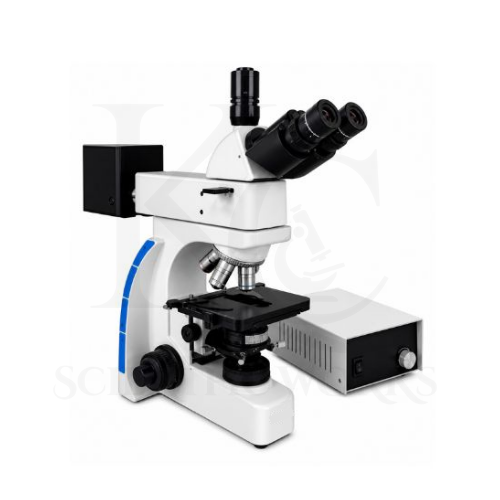
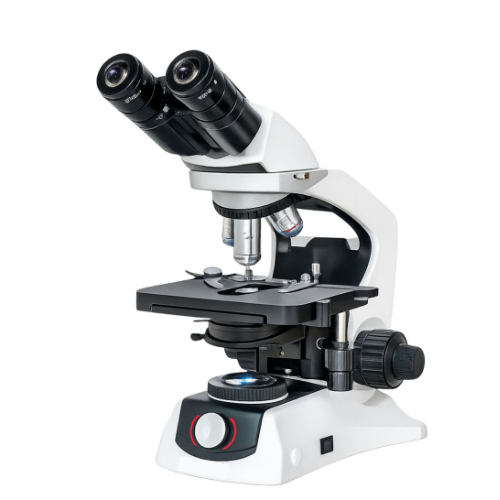
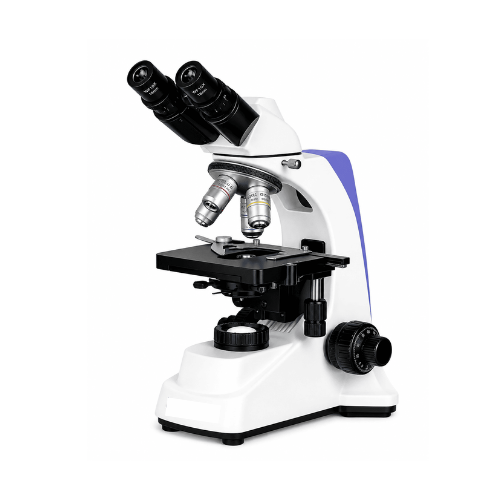
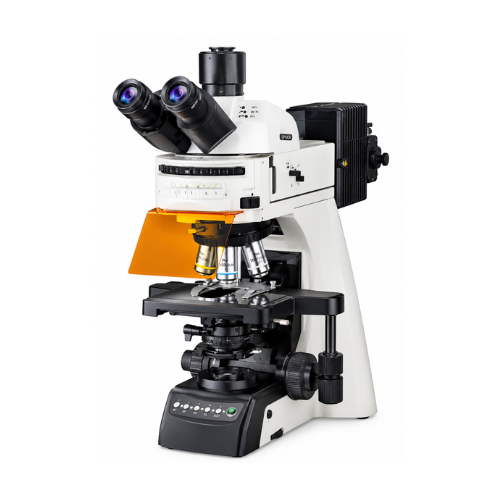
The Upright Metallurgical Microscope KCX-205 is intended for magnified examination of metals, alloys, industrial components, polished metallographic specimens, coatings, ceramics and other suitable engineering materials.
A metallurgical microscope uses reflected light to observe opaque specimens that cannot be examined effectively using conventional transmitted-light microscopy.
The reflected illumination is directed toward the specimen surface through a compatible optical system.
Light reflected from the specimen is collected by the objective lens and forms a magnified image.
The infinity-corrected optical system supports image formation using compatible objective and tube-lens components.
The WF10X eyepieces provide visual observation.
The trinocular head allows a compatible camera to be connected for digital image documentation.
The mechanical stage allows controlled specimen positioning.
The coaxial focusing system supports precise adjustment of image sharpness.
The analyzer and polarizer arrangement may be used for suitable specialized material observations.
The KCX-205 is intended for metallurgical research, industrial quality control, material inspection, engineering education and manufacturing laboratories.
Applications
1. Metallurgical Laboratories
The KCX-205 Upright Metallurgical Microscope supports microscopic examination of prepared metal specimens.
2. Material Testing Laboratories
The microscope can be used for suitable material structure examination.
3. Steel Manufacturing Industries
The KCX-205 supports inspection of appropriately prepared steel specimens.
4. Foundries
The microscope can be used for examination of prepared casting samples.
5. Automotive Component Manufacturing
The KCX-205 supports suitable microscopic inspection of automotive material samples.
6. Aerospace Material Research
The microscope may be used for examination of appropriately prepared aerospace engineering materials.
7. Mechanical Engineering Laboratories
The KCX-205 supports metallurgical microscopy education.
8. Welding and Fabrication Industries
The microscope can be used for observation of prepared weld cross-sections.
9. Heat Treatment Laboratories
The KCX-205 supports microscopic examination of heat-treated material specimens.
10. Casting Inspection
The microscope can be used to observe suitable prepared casting structures.
11. Failure Analysis Laboratories
The KCX-205 supports optical examination of appropriate failure-analysis specimens.
12. Industrial Quality Control
The microscope can assist with microscopic inspection and documentation.
13. Research and Development Laboratories
The KCX-205 supports suitable material science research.
14. Universities and Engineering Colleges
The microscope can be used for teaching metallurgical microscopy.
15. Industrial Research Institutions
The KCX-205 supports suitable scientific material observation.
16. Coating Examination
The microscope may be used for observation of suitable prepared coating surfaces and sections.
17. Metal Surface Analysis
The KCX-205 supports magnified examination of suitable metal surfaces.
18. Electronics Material Inspection
The microscope can be used for suitable microscopic inspection of industrial electronic materials.
19. Manufacturing Quality Inspection
The KCX-205 supports visual examination of prepared manufacturing samples.
20. Scientific Image Documentation
A compatible camera connected to the trinocular port can support digital documentation of microscope observations.
Typical Examination and Research
| Material or Specimen | Observation Purpose |
|---|
| Polished Steel Sections | Microstructure examination |
| Aluminium Alloys | Material structure observation |
| Copper Alloys | Surface and grain examination |
| Cast Iron Samples | Casting microstructure |
| Weld Cross-Sections | Weld structure examination |
| Heat-Treated Steel | Microstructural changes |
| Metal Coatings | Coating surface observation |
| Plated Components | Surface inspection |
| Prepared Fracture Samples | Failure investigation |
| Industrial Metal Components | Surface characteristics |
| Polished Metallographic Samples | Phase and grain structure |
| Ceramic Materials | Suitable surface examination |
| Engineering Materials | General material observation |
| Prepared Casting Samples | Structural characteristics |
Working Principle
The Upright Metallurgical Microscope KCX-205 operates using reflected-light optical microscopy.
The specimen is positioned on the microscope stage.
The reflected-light illumination system directs light toward the surface of the specimen.
Light reflected from the specimen enters the objective lens.
The objective collects the reflected light and forms an optical image through the microscope's infinity-corrected optical system.
The eyepiece magnifies the image for visual observation.
The trinocular viewing head provides an additional optical path for a compatible digital camera.
The mechanical stage allows the specimen to be moved in the X and Y directions.
The coaxial focusing system adjusts the optical focus.
For suitable polarized-light observations, a polarizer and analyzer can be introduced into the optical path according to the installed configuration.
The microscope can therefore be used for appropriate metallurgical observation, material examination and image documentation.
Basic Observation Procedure
Microscope Setup: Place the KCX-205 on a stable laboratory surface.
Power Connection: Connect the microscope to a suitable 110V–240V supply.
Optical Inspection: Check the eyepieces and objective lenses.
Specimen Preparation: Prepare the metallurgical specimen according to the intended observation method.
Specimen Placement: Position the specimen on the mechanical stage.
Illumination Selection: Select the reflected-light illumination system for opaque specimens.
LED Activation: Switch on the LED light source.
Initial Objective Selection: Begin with the 5X objective.
Stage Positioning: Use the mechanical stage controls to locate the observation area.
Coarse Focusing: Bring the specimen into initial focus.
Fine Focusing: Adjust the image for sharp observation.
Brightness Adjustment: Set the LED intensity as required.
Higher Magnification: Select the 10X, 20X or 50X objective when appropriate.
Refocusing: Use fine focusing after changing objectives.
Polarization Selection: Use compatible analyzer and polarizer components if required.
Specimen Examination: Observe the relevant surface or structural features.
Digital Imaging: Connect a compatible camera if available.
Image Documentation: Capture and record the required observations.
Completion: Return the microscope to a suitable resting position.
Storage: Switch off the illumination and protect the microscope after use.
Magnification System
The KCX-205 incorporates WF10X eyepieces and a reference objective configuration of 5X, 10X, 20X and 50X.
An optional 100X objective is also specified.
Total Visual Magnification = Objective Magnification × Eyepiece Magnification
| Objective | Numerical Aperture | Total Magnification with WF10X | Configuration |
|---|
| 5X | 0.15 | 50X | Standard Reference |
| 10X | 0.30 | 100X | Standard Reference |
| 20X | 0.45 | 200X | Standard Reference |
| 50X | 0.80 | 500X | Standard Reference |
| 100X | 0.90 | 1000X | Optional |
Standard reference magnification range: 50X–500X.
Maximum magnification with optional 100X objective: 1000X.
The original reference lists 50X–1000X as the overall range, but reaching 1000X requires the optional 100X objective.
Infinity Optical System
The KCX-205 features an infinity-corrected optical arrangement.
Optical Specifications
| Parameter | Specification |
|---|
| Optical System | Infinity Corrected |
| Objective Type | Infinity Flat-Field Metallurgical Achromatic |
| Viewing Head | Siedentopf Trinocular |
| Eyepieces | WF10X / FN22 |
| Standard Objectives | 5X, 10X, 20X and 50X |
| Optional Objective | 100X |
| Reflected-Light Observation | Specified |
| Polarizer and Analyzer | Referenced |
Trinocular Viewing Head
The microscope incorporates a Siedentopf trinocular observation head.
| Parameter | Specification |
|---|
| Head Type | Siedentopf Trinocular |
| Inclination | 30° |
| Rotation | 360° |
| Interpupillary Distance | 50–75 mm |
| Eyepiece Magnification | 10X |
| Eyepiece Field Number | 22 mm |
| Diopter Adjustment | ±5 |
| Eye Guards | Adjustable Rubber |
| Eyepiece Treatment | Anti-Fungal |
| Eyepiece Coating | Anti-Reflection |
| Camera Port | Trinocular |
| Camera Adapter | Not Specified |
| Camera Included | Not Specified |
Metallurgical Objective System
The KCX-205 reference specifies infinity flat-field metallurgical achromatic objectives.
| Objective | N.A. | Optical Type |
|---|
| 5X | 0.15 | Infinity Metallurgical Achromatic |
| 10X | 0.30 | Infinity Metallurgical Achromatic |
| 20X | 0.45 | Infinity Metallurgical Achromatic |
| 50X | 0.80 | Infinity Metallurgical Achromatic |
| 100X | 0.90 | Optional Metallurgical Objective |
The individual working distances and objective correction standards are not specified.
Quadruple Revolving Nosepiece
| Parameter | Specification |
|---|
| Nosepiece Type | Quadruple |
| Positions | 4 |
| Rotation | Revolving |
| Positioning Mechanism | Click-Stop |
| Grip | Rubber |
| Standard Reference Objectives | 4 |
| Optional 100X Objective | Requires Replacement of an Installed Objective or Another Compatible Nosepiece Arrangement |
Mechanical Stage
The KCX-205 incorporates a double-plate graduated mechanical stage.
| Parameter | Specification |
|---|
| Stage Type | Double-Plate Mechanical |
| Stage Size | 140 × 120 mm |
| X-Axis Travel | 80 mm |
| Y-Axis Travel | 55 mm |
| Stage Graduations | Provided |
| Slide Holder | Double |
| Stage Load Capacity | Not Specified |
| Metallurgical Sample Clamp | Not Specified |
Reflected-Light Illumination System
The KCX-205 reference includes reflected-light illumination for opaque metallurgical specimens.
| Parameter | Specification |
|---|
| Observation Method | Reflected Light |
| LED Power | 5W |
| Brightness Adjustment | Intensity Controller |
| Claimed LED Lifespan | Up to 100,000 Hours |
| Brightfield Observation | Specified |
| Darkfield Observation | Not Specified |
| Polarization | Referenced |
| Analyzer | Referenced |
| DIC | Not Specified |
The reference does not provide the reflected-light illuminator's internal optical layout or whether the 5W LED is shared with a separate transmitted-light system.
Condenser System
The reference specifies a movable Abbe condenser.
| Parameter | Specification |
|---|
| Condenser Type | Abbe |
| Numerical Aperture | 1.25 |
| Lens | Aspheric |
| Movement | Rack and Pinion |
| Centering Device | Provided |
| Condenser Position | Not Specified |
| Transmitted-Light Source | Not Explicitly Specified |
Technical note: An Abbe condenser is associated with transmitted-light microscopy. It is not the primary illumination component used for reflected-light examination of opaque metal surfaces.
Polarizer and Analyzer System
The KCX-205 reference includes analyzer and polarizer functionality.
| Parameter | Specification |
|---|
| Polarizer | Referenced |
| Analyzer | Referenced |
| Polarized-Light Observation | Referenced |
| Polarizer Rotation | Not Specified |
| Analyzer Rotation | Not Specified |
| Compensators | Not Specified |
| DIC Components | Not Specified |
The actual polarization accessories and their placement should be verified against the final KCX-205 configuration.
Optical Filters
The microscope reference includes three filters.
| Filter | Reference Specification |
|---|
| Blue | Included |
| Green | Included |
| Yellow | Included |
The reference does not specify the spectral transmission characteristics or filter mounting positions.
Coaxial Focusing System
The microscope incorporates coarse and fine focusing.
| Parameter | Specification |
|---|
| Coarse Focusing | Provided |
| Fine Focusing | Provided |
| Control Arrangement | Coaxial |
| Fine Focus Resolution | Not Specified |
| Focus Travel | Not Specified |
| Tension Control | Not Specified |
| Focus Stop | Not Specified |
Aluminum Die-Cast Construction
The KCX-205 features an aluminum die-cast stand.
| Parameter | Specification |
|---|
| Stand Material | Aluminum Die-Cast |
| Body Treatment | Anti-Rust |
| Observation Head | Trinocular |
| Stage | Mechanical |
| Electrical Supply | 110V–240V |
| Weight | Not Specified |
| Dimensions | Not Specified |
Digital Imaging and Camera Compatibility
The trinocular head provides an optical path for compatible digital imaging equipment.
| Parameter | Specification |
|---|
| Camera Port | Trinocular |
| Camera Included | Not Specified |
| Camera Adapter | Not Specified |
| Camera Resolution | Not Specified |
| Camera Interface | Not Specified |
| Measurement Software | Not Specified |
| Image Capture | Possible with Compatible Camera |
| Video Recording | Depends on Camera |
| Computer Included | Not Specified |
Educational and Industrial Benefits
The KCX-205 Upright Metallurgical Microscope supports:
Metallurgical specimen examination
Material science education
Metal microstructure observation
Industrial quality control
Prepared steel specimen inspection
Alloy examination
Casting structure observation
Weld section examination
Heat treatment research
Engineering laboratory training
Industrial material inspection
Coating examination
Material surface observation
Metallography demonstrations
Research laboratory observation
Optical magnification training
Digital microscopy compatibility
Scientific image documentation
Mechanical stage positioning
Metallurgical microscopy education
Microscope Compatibility and Usage
The KCX-205 Upright Metallurgical Microscope is intended for metallurgical laboratories, engineering colleges, industrial research facilities and suitable material inspection applications.
Opaque metal specimens should be observed using the reflected-light illumination system.
Specimens should be prepared according to the intended metallographic examination method.
The appropriate objective should be selected for the required observation.
The mechanical stage should be adjusted to position the specimen.
The coarse focusing mechanism should be used for initial focusing.
The fine focusing mechanism should be used to refine the image.
The LED intensity should be adjusted for suitable specimen visibility.
Compatible analyzer and polarizer components may be used for specialized observations.
A compatible digital camera may be connected through the trinocular port for image documentation.