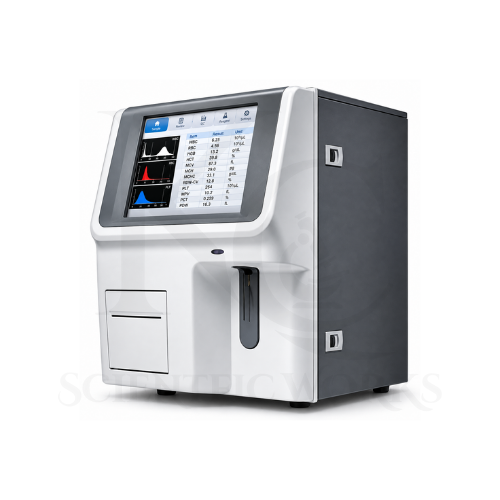
The Automatic Hematology Analyzer KCX-329 is intended to support laboratory measurement of blood cell counts and related hematological indices.
The analyzer processes compatible blood samples and generates numerical results associated with red blood cells, white blood cells, hemoglobin, and platelets.
It also provides cell-distribution histograms that laboratory professionals can review alongside the numerical results.
The KCX-329 is designed to support routine hematology workflows by combining automated measurement, result storage, quality-control functions, and reporting capabilities.
Its multiple sampling modes and low sample-volume requirements make it useful for laboratories processing different types of blood specimens.
The analyzer's touchscreen interface, printing capabilities, and LIS support assist in managing testing and laboratory documentation.
Working Principle
The KCX-329 operates as an automatic hematology analyzer that processes blood samples using an internal analytical system.
In general, automatic hematology analyzers perform cell counting and related measurements through instrument-specific detection and analytical methods.
The instrument processes the sample, generates measurement signals, and converts the acquired data into hematological results and distribution histograms.
General Analytical Workflow
Sample Collection: A suitable blood sample is collected according to laboratory procedures.
Sample Selection: The appropriate venous, capillary, or prediluted mode is selected.
Sample Processing: The analyzer processes the sample using its reagent and measurement systems.
Cell Analysis: Hematological measurements are performed by the internal analytical system.
Parameter Calculation: The analyzer generates the supported blood cell counts and related indices.
Histogram Generation: WBC, RBC, and PLT histograms are produced.
Result Display: The measured results are presented on the touchscreen.
Quality Review: Laboratory personnel review results, flags, and applicable quality-control information.
Result Storage: Sample results and histograms are saved in the analyzer's memory.
Reporting: Results can be printed or transferred through a compatible LIS connection.
Technical note: The supplied specifications do not identify the exact cell-counting technology, hemoglobin measurement method, or internal detection mechanism. These should be verified from the manufacturer's technical documentation rather than assumed.
Applications
1. Hospital Laboratories
The KCX-329 supports routine hematology testing workflows in hospital laboratory environments.
2. Diagnostic Laboratories
The analyzer is suitable for laboratories performing automated blood cell count measurements and related hematological investigations.
3. Pathology Laboratories
It supports hematological sample analysis as part of appropriate laboratory testing workflows.
4. Clinical Laboratories
The analyzer assists clinical laboratory personnel in measuring and recording blood cell parameters.
5. Medical Colleges
The KCX-329 can support practical instruction in hematology instrumentation, laboratory quality control, and automated blood analysis.
6. Medical Research Laboratories
The analyzer can assist with hematological measurements in research activities where its validated performance meets the study requirements.
7. Laboratory Technician Training
The instrument supports training in automated hematology analysis, sample processing, result interpretation, and instrument quality control.
8. Hematology Departments
The analyzer can be used for supported blood cell measurements in hematology laboratory workflows.
9. Healthcare Diagnostic Centers
Its automated testing, data storage, and reporting functions can assist diagnostic centers handling routine hematology samples.
10. Biomedical Research Facilities
The KCX-329 may support research requiring blood cell count measurements and related hematological indices.
Benefits of the KCX-329
The KCX-329 offers several practical benefits for suitable laboratory environments.
Automated testing: Reduces dependence on manual counting for supported hematological parameters.
Consistent workflow: Combines sample processing, measurement, result display, and reporting within one instrument.
Low sample-volume requirement: Supports testing with the specified small sample volumes.
Quality-control features: Provides three-level QC and LJ graphs for laboratory performance monitoring.
Data management: Stores up to 100,000 results with histograms for later retrieval.
Reporting flexibility: Supports integrated thermal printing, external printing, and LIS connectivity.
User-friendly operation: The touchscreen and multilingual interface support routine laboratory use.
Reagent System
The KCX-329 specification identifies two reagents:
| Reagent | Specified Pack Size |
|---|
| Lyse | 500 mL |
| Diluent | 20 L |
The diluent is used within the analyzer's supported sample-processing system, while the lyse reagent supports the instrument's hematology analytical workflow.
Only reagents approved for the KCX-329 configuration should be used. Reagent compatibility, storage conditions, and replacement procedures should follow the manufacturer's instructions.
Quality Control and Calibration
The KCX-329 includes manual and automatic calibration functions, together with three-level quality control.
Quality control is important for monitoring whether instrument measurements remain within established laboratory performance limits.
The specified Levey–Jennings graph provides a visual method for monitoring quality-control results over time.
Calibration and quality-control procedures should be performed using suitable materials, validated limits, and the manufacturer's operating instructions.